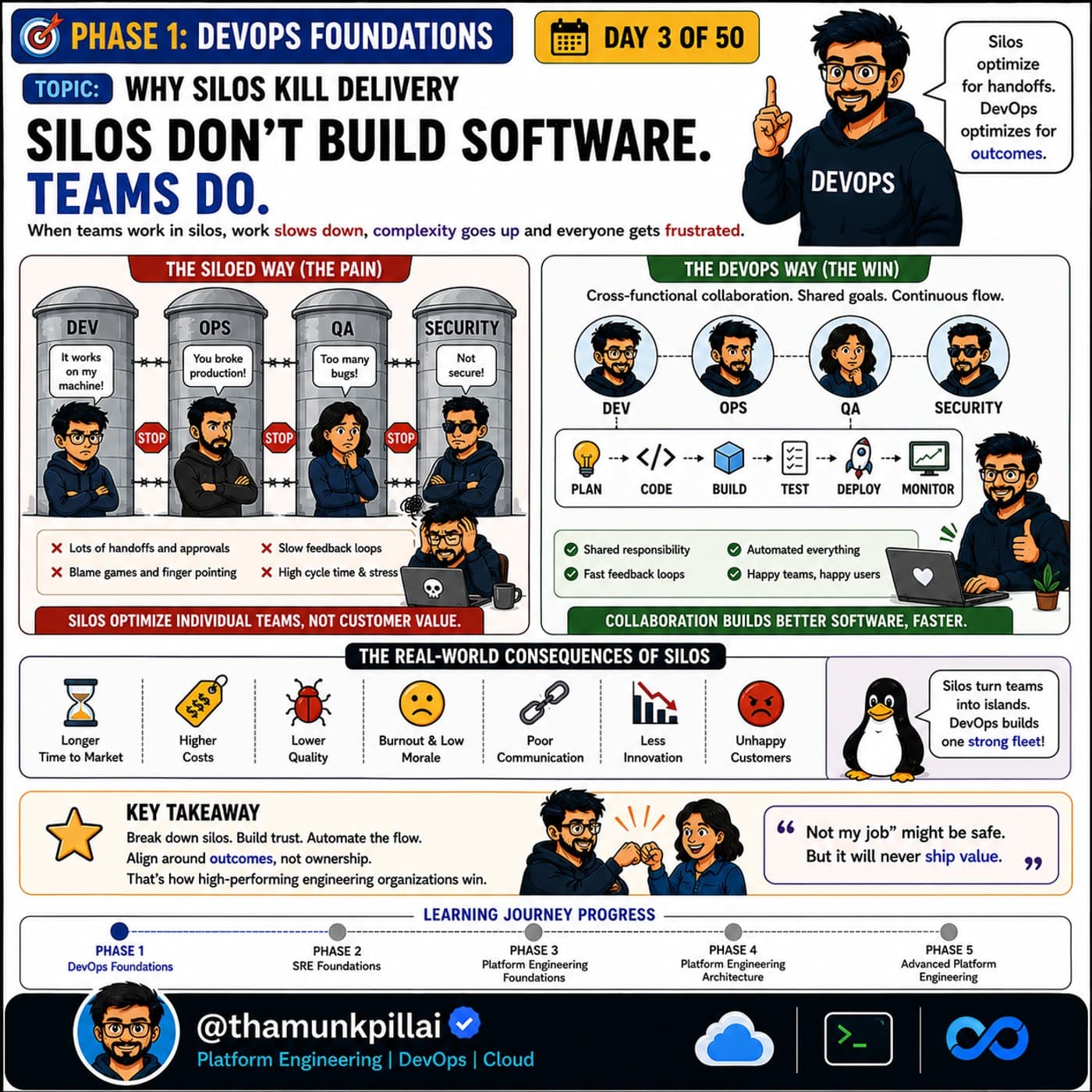
"Communicate more" is the most common advice given to siloed teams and one of the least effective, because silos are rarely a communication failure in the first place. They're an incentive structure working exactly as designed. Dev is measured on features shipped. Ops is measured on uptime. QA is measured on bugs caught before release. Security is measured on nothing getting past them. Every one of those metrics is locally sensible, and every one of them can be improved by making a different team's job harder.
The wall is a rational response, not a communication gap
When operations is judged solely on uptime, the single highest-leverage move available to them is resisting change — because change is statistically the leading cause of outages. That's not operations being obstructionist. That's operations correctly optimizing for the number they're held to. The same logic applies in reverse: a developer measured only on features shipped has no formal reason to spend a sprint hardening observability for a service that already "works."
Note
If you want to predict where a silo will form, don't look at org charts. Look at where two teams' success metrics can move in opposite directions from the same change. That's where the wall goes up, regardless of how well those two teams get along personally.
This is why "silos are a culture problem, let's do more standups" fixes are so consistently disappointing. You can improve communication between two teams whose incentives are still pointed at each other, and the wall reappears the moment the standup ends, because the underlying math hasn't changed.
What breaking silos actually requires
The DevOps answer to this isn't "everyone talk more." It's cross-functional ownership of outcomes, which changes what each team is actually optimizing for:
- Shared metrics. If dev and ops both carry some responsibility for both delivery speed and stability, the tension between them stops being adversarial and starts being a genuine trade-off both sides have a stake in getting right.
- Shared on-call. Nothing collapses "it works on my machine, not my problem" faster than the person who wrote the code being the one who gets paged when it breaks at 2 a.m.
- A shared pipeline. Plan, code, build, test, deploy, and monitor as one continuous flow that multiple functions touch, instead of a relay race with a handoff — and a blame boundary — at every stage.
The real-world cost, measured
The consequences of silos aren't abstract. They compound into specific, measurable outcomes: longer time to market, because every release needs cross-team coordination that didn't need to be a negotiation. Lower quality, because feedback between the people who build and the people who operate arrives too late to act on. Burnout, from constant context-switching between "build mode" and "firefight mode" with no shared ownership to spread the load. And, less obviously, less innovation — because a team that's spending its energy on handoffs and blame has less left over for anything ambitious.
Warning
"Not my job" is organizationally safe and individually defensible. It is also incompatible with shipping reliable software, because reliability lives in the gaps between teams — and nobody owns the gaps by default.
What replaces the wall
The DevOps way — cross-functional collaboration, shared goals, continuous flow — isn't a values statement. It's plan, code, build, test, deploy, and monitor treated as one loop that dev, ops, QA, and security all have visibility into and stake in, rather than four separate loops connected by tickets.
That doesn't mean flattening every team into one undifferentiated blob. Specialization is still useful — you still want people who are deeply good at security, or deeply good at reliability engineering. What changes is that their success is tied to the same outcome as everyone else's, instead of being measured by how effectively they can say no to the team next to them.
Align around outcomes, not ownership boundaries. That's the actual fix — not more meetings, a different set of numbers on the performance review.