Go back to Day 3 of this series: "Silos Don't Build Software. Teams Do." That argument was about culture and ownership. Today's article is the same argument, one more time, at the reliability layer specifically — because siloed reliability work has its own distinctive failure signature, and it's worth naming precisely before looking at what fixes it.
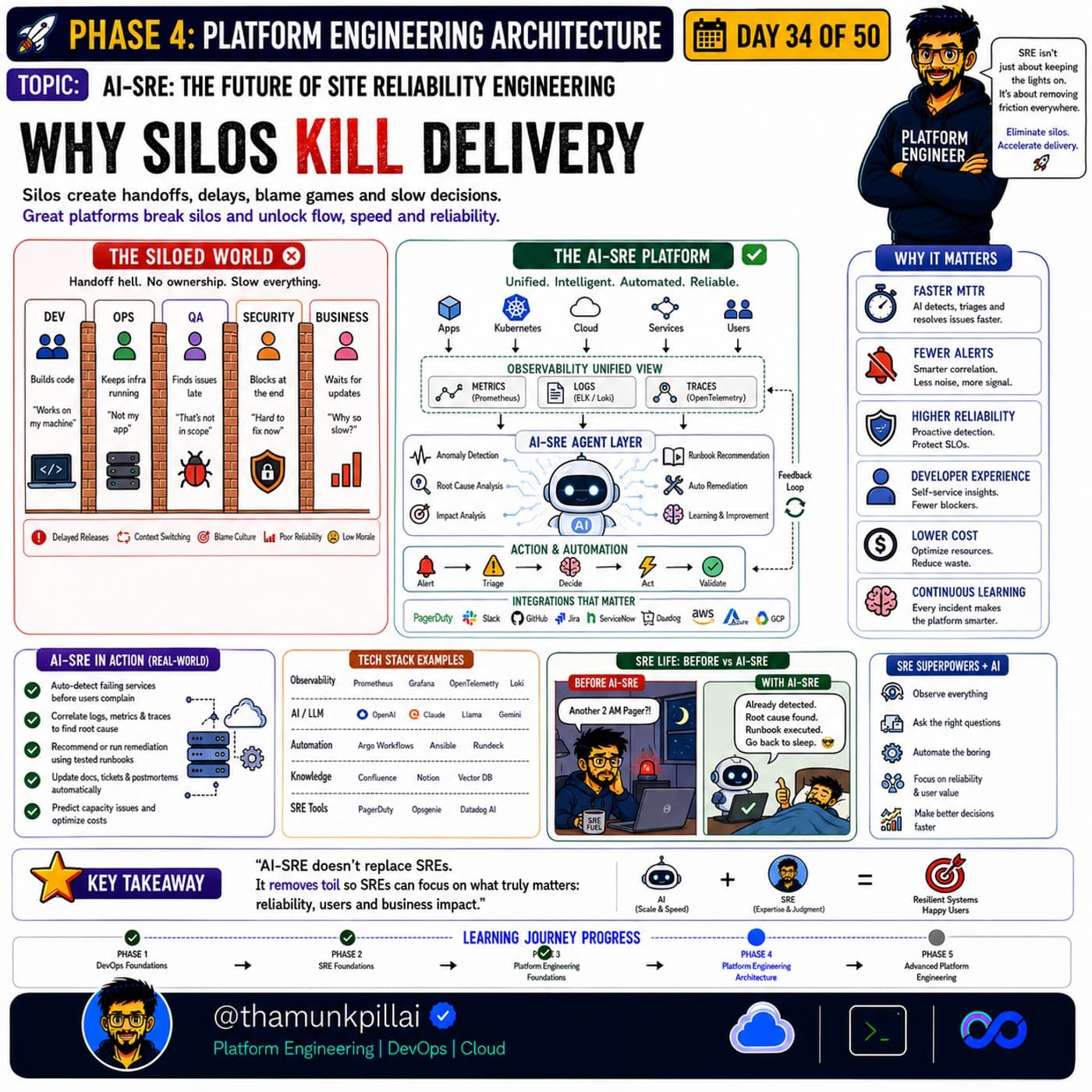
In the siloed world, Dev builds code and says "works on my machine." Ops keeps infrastructure running and says "not my app." QA finds issues late and says "that's not in scope." Security blocks at the end. Business waits for updates and asks "why so slow." Each function has a partial, disconnected view of the same system, and every handoff between those views is a place information gets lost, delayed, or reinterpreted. The result, predictably, is delayed releases, constant context switching, a blame culture, poor reliability, and low morale.
Note
SRE isn't just about keeping the lights on. It's about removing friction everywhere — the same claim this series made about platform engineering back on Day 20, applied specifically to reliability work. AI-SRE is what that removal looks like once the observability from Day 32 and the automation from Day 33 are pointed directly at incident response.
The unified view a silo can't produce on its own
AI-SRE PLATFORM: unified, intelligent, automated, reliable

  Apps, Kubernetes, Cloud, Services, Users
        ↓
  OBSERVABILITY UNIFIED VIEW
    Metrics (Prometheus) · Logs (ELK/Loki) · Traces (OpenTelemetry)
        ↓
  AI-SRE AGENT LAYER
    Anomaly Detection · Root Cause Analysis · Impact Analysis
    Runbook Recommendation · Auto Remediation · Learning & Improvement
        ↓
  ACTION & AUTOMATION
    Alert → Triage → Decide → Act → Validate
        ↺ (feedback loop back into the agent layer)
The property that actually breaks the silo is the "unified view" step. Dev's logs, Ops' infrastructure metrics, and the traces connecting a request across every service it touches all land in one correlated place instead of five separate systems that only a cross-functional incident call can reconcile. The AI-SRE agent layer sits on top of that unified view precisely because correlation across silos is a harder, more valuable problem than any one silo's local view can solve.
What actually changes for the person on call
| Before AI-SRE | With AI-SRE |
|---|---|
| Auto-detect a failing service only after a user complains | Detected before users notice, correlated automatically |
| Manually correlate logs, metrics, and traces across teams | Root cause found automatically, across the whole unified view |
| Improvise a fix under pressure, hope it's right | Tested runbook recommended, or safe remediation runs directly |
| Docs and postmortems written from memory afterward | Documentation and postmortem drafts generated as it happens |
| Capacity planning is reactive, done after a scare | Capacity issues predicted, costs optimized continuously |
The 2am-pager scenario is the clearest version of this: without AI-SRE, an engineer wakes up to "another page," starts from zero, and reconstructs what's wrong. With it, the detection, root cause, and a recommended (or already-executed) runbook are waiting before the engineer even opens their laptop — the difference between starting an investigation and reviewing a conclusion.
What the tech stack actually looks like
Prometheus, Grafana, OpenTelemetry, and Loki for the observability layer this series built up on Day 32; an LLM (any of the major providers) for the reasoning layer; Argo Workflows or Ansible for automated remediation; PagerDuty or Opsgenie for the human-facing loop when automation isn't confident enough to act alone. None of this requires exotic infrastructure — it's the same stack most SRE teams already run, with a correlation and reasoning layer added on top.
The equation this article is actually making
"AI-SRE doesn't replace SREs. It removes toil so SREs can focus on what truly matters: reliability, users, and business impact." That's a direct callback to Day 12's argument about toil — automatable, repetitive, non-durable work — applied specifically to incident response. AI (scale and speed) plus SRE (expertise and judgment) is the equation, not AI instead of SRE. The silos this article opened with don't get removed by adding more process between them; they get removed by giving every function the same unified, correlated view, with an agent layer doing the correlation work no single silo could do watching only its own slice.
Tomorrow's article moves to the specific protocol making a version of this possible for AI agents generally: the Model Context Protocol, and why giving an AI system access to real engineering context — not just a chat window — is what separates a genuinely useful engineering copilot from a chatbot that has to be told everything by hand.