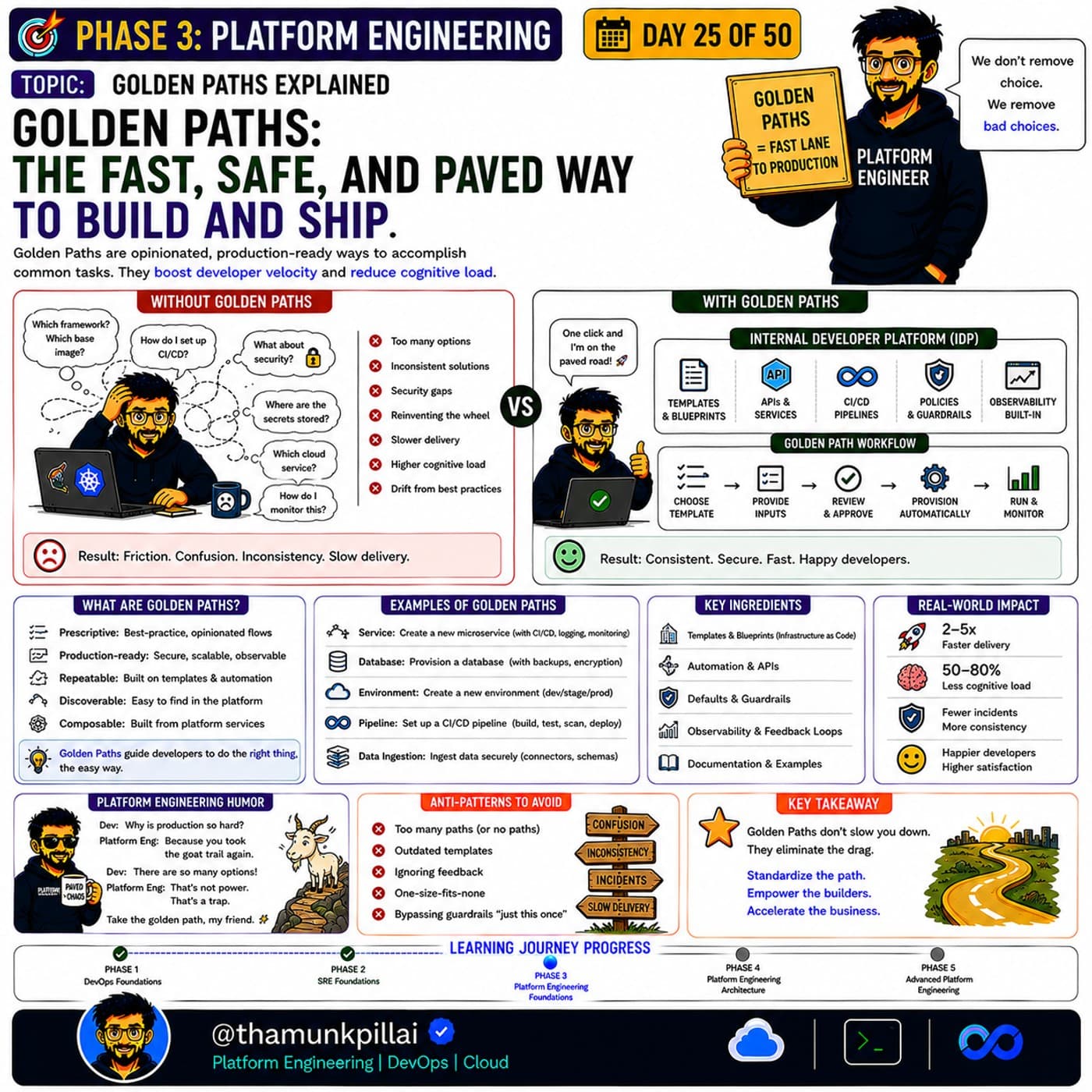
Yesterday's article ended on self-service needing something more than speed — it needs the request that comes through to already be the right one. That's what a golden path provides. A golden path is an opinionated, production-ready way to accomplish a common task: standing up a new microservice, provisioning a database, setting up a CI/CD pipeline. It's prescriptive by design, and that's the entire point — it's the difference between "here are forty ways to do this, good luck" and "here's the way that's secure, scalable, and observable by default."
Note
The framing that resolves most objections to golden paths before they start: "we don't remove choice, we remove bad choices." A golden path doesn't forbid the alternative approach — it just means the alternative isn't the default, isn't automatically supported, and doesn't inherit the guardrails and observability that come free with the paved road.
Without a golden path, every team pays the tax independently
"Which framework?"        "How do I set up CI/CD?"
"What about security?"    "Where are the secrets stored?"
"Which cloud service?"    "How do I monitor this?"
None of these questions are hard for one experienced engineer to answer once. The cost is that without a golden path, every team answers them independently, at a different quality bar, at a different point in their own learning curve — which is exactly the "ten teams solving the same infrastructure problem badly" pattern this series has come back to since Day 20. A golden path is that answer, worked out once by people who specialize in it, and made the default.
What actually makes up a golden path
| Ingredient | What it provides |
|---|---|
| Templates & blueprints | The starting point, already production-shaped |
| Automation & APIs | The mechanism that provisions it without manual steps |
| Defaults & guardrails | Security and compliance baked in, not bolted on later |
| Observability & feedback loops | Dashboards and logging that exist from commit one |
| Documentation & examples | The "how do I use this" answer, in the platform itself |
A workflow built from those five pieces looks like: choose a template, provide the specific inputs your service actually needs, get automatic review against policy, get provisioned automatically, and land on a service that's already running and monitored. Compare that to the without-golden-path version — reinventing the wheel, inconsistent solutions, security gaps discovered later, slower delivery, and drift from whatever the org considers best practice this quarter.
The trade-off golden paths are explicit about
Golden paths only work if they're genuinely the fast option, not the compliant-but-slower one. If following the golden path takes longer than doing it manually, developers will do it manually — and now there's an unofficial path running in parallel with the official one, which is worse than no golden path at all, because nobody's tracking what's actually running in production anymore.
Anti-pattern: "too many paths, or no paths" — either overwhelming
choice with no clear default, or a single rigid path with zero
flexibility for anything that doesn't fit the template exactly.

What works: one clear default, fast enough that following it is
obviously easier than not, with an explicit, documented process
for the genuine exception.
Golden paths guide, they don't gate
The distinction matters: a golden path is a recommendation with excellent defaults, not a locked door. Day 26 of this series goes deep on the mechanism that keeps golden paths from calcifying into gates — guardrails instead of approval gates, so the paved road stays fast even as it stays safe.
What teams actually get back
The measured outcomes — 2-5x faster delivery, 50-80% less cognitive load, fewer incidents, more consistency, happier developers — are the same shape of number this series has seen for self-service and for cognitive load reduction generally, because golden paths are the concrete mechanism that produces both. A golden path doesn't just make the first deploy easier. It makes every deploy that follows the same shape, which is what actually compounds into fewer incidents over a year, not just a faster afternoon.
Tomorrow's article covers the piece that keeps a golden path from quietly turning into exactly the kind of approval-gate bureaucracy it was built to replace: the difference between building gates and building guardrails, and why the org that gets this distinction wrong ends up right back where it started — developers filing tickets and waiting.