Day 1 of this series opened with a single question: how do you close the gap between building software and running it? Forty-nine days later, the honest answer turned out to require five phases, each one built directly on the phase before it. This last article isn't a new topic — it's the map of how everything connected, for anyone arriving at Day 50 first, or anyone who read all forty-nine and wants the throughline made explicit.
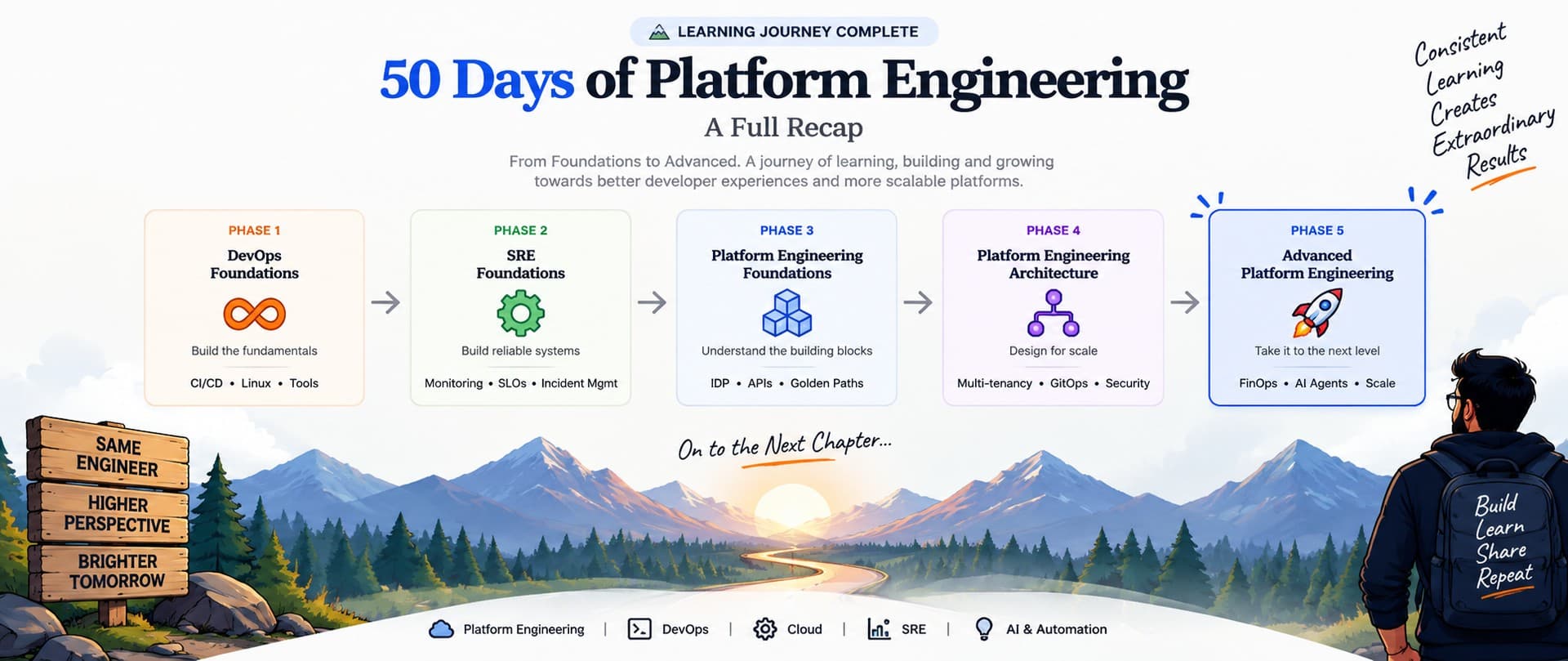
Phase 1 — DevOps Foundations (Days 1–9)
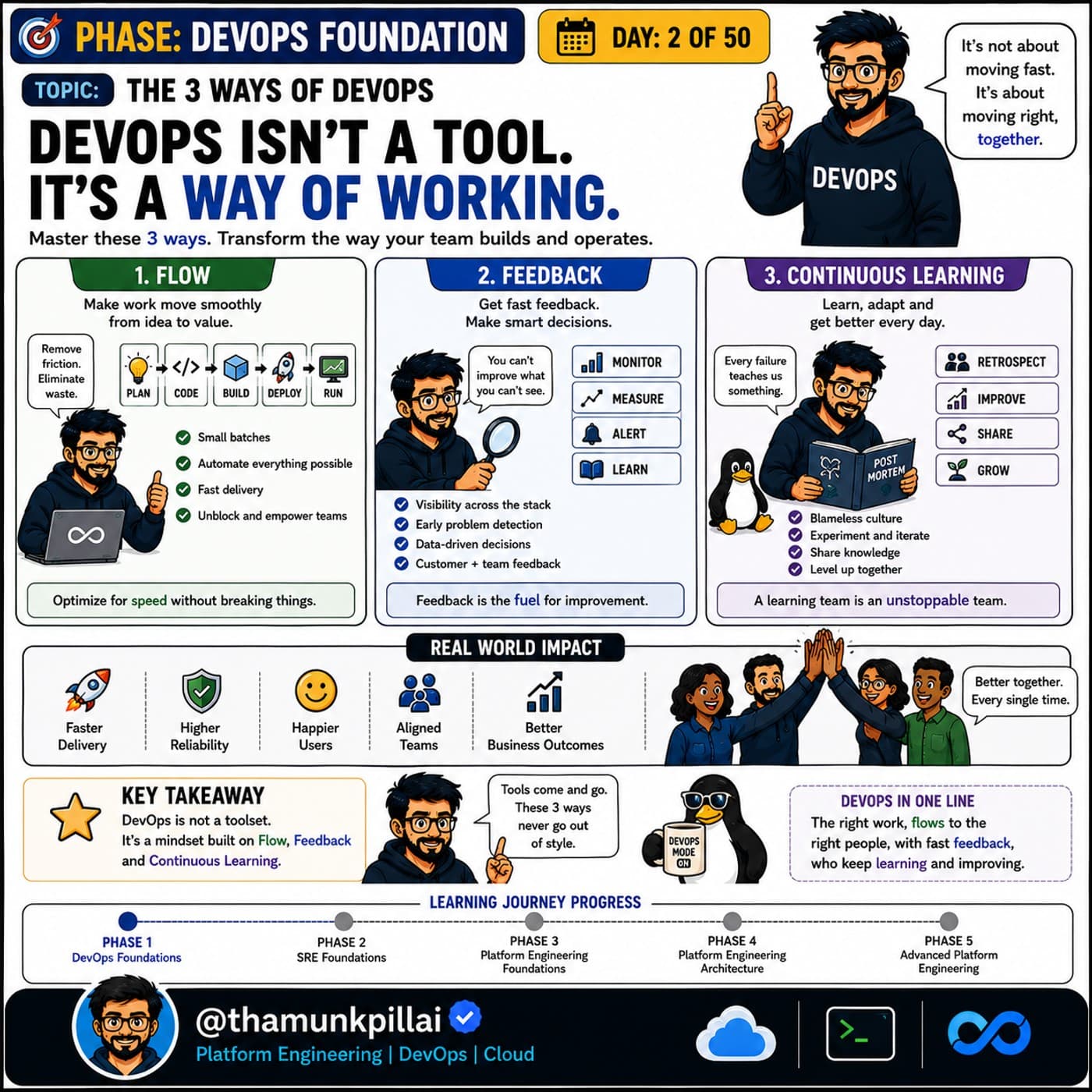
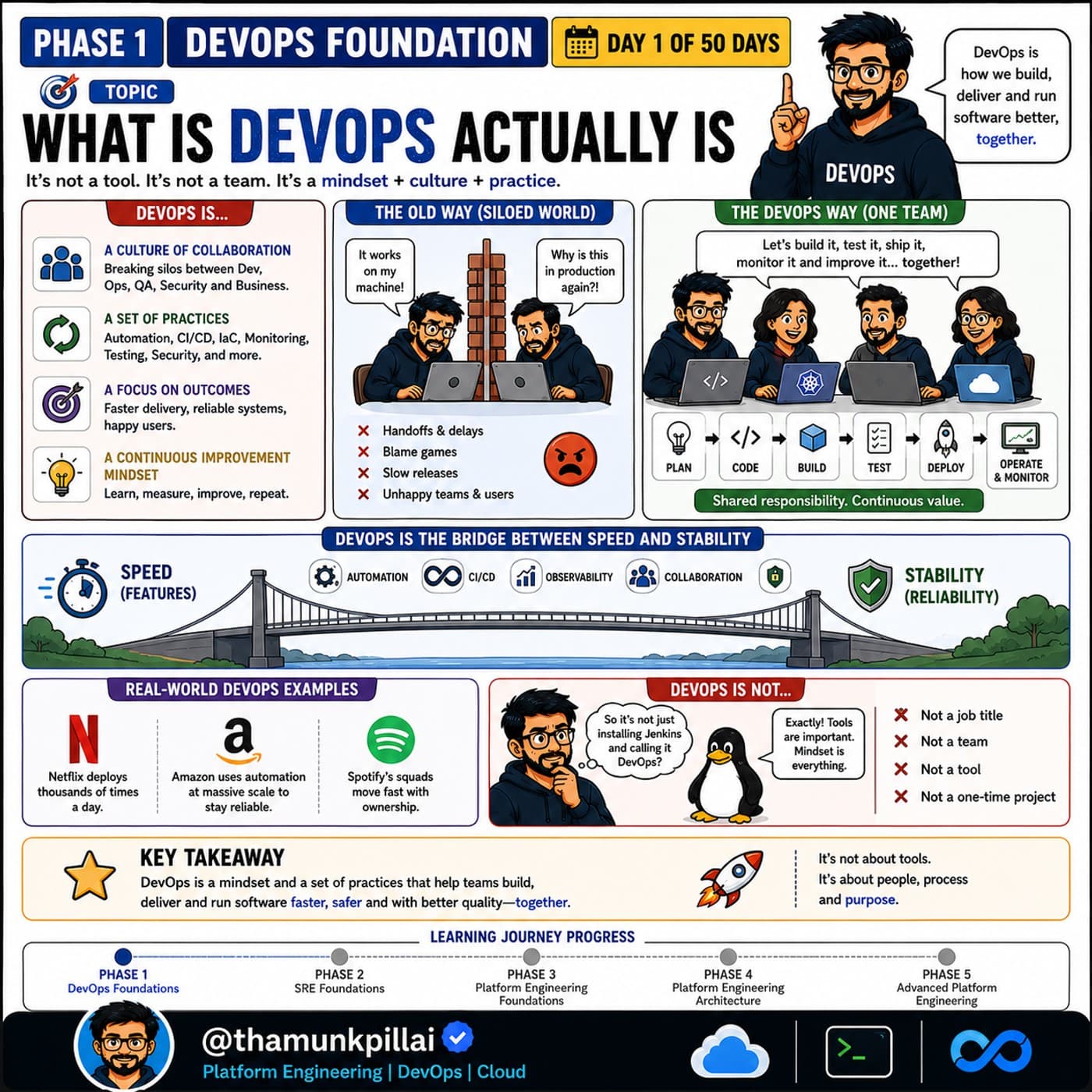
The series opened by separating DevOps-the-practice from DevOps-the-job-title (Day 1), then grounded it in the actual theory — the Three Ways (Day 2) — before making the cultural case: silos don't build software, teams do (Day 3), and automation beats heroics every time (Day 4). From there it moved into the technical foundation everything else depends on: infrastructure as code, first as a fundamental practice (Day 5), then as a discipline with real rigor behind it (Day 6). Immutable infrastructure (Day 7), shift-left testing (Day 8), and everything-as-code (Day 9) rounded out the phase — the common thread being that nothing downstream works if the artifact reaching production isn't exactly the artifact that was tested and declared in code.
Phase 2 — SRE Foundations (Days 10–17)
Phase 2 asked why reliability has to be engineered in rather than hoped for (Day 10), then made it measurable with SLIs, SLOs, and error budgets (Day 11) — the number that ends arguments about "is this reliable enough" by replacing vibes with arithmetic. Toil (Day 12) was named as the tax on time that should be going toward exactly that engineering work, and observability (Day 13) as the capability that tells you why something broke, not just that it did. MTTR over MTBF (Day 14) reframed reliability around recovery speed rather than failure avoidance, Day 15 synthesized the whole phase as "reliability is a feature, not an afterthought," and blameless postmortems (Day 16) plus real incident management (Day 17) closed it out with the practices that turn an incident into a permanent fix instead of a monthly rerun.
Phase 3 — Platform Engineering Foundations (Days 18–27)
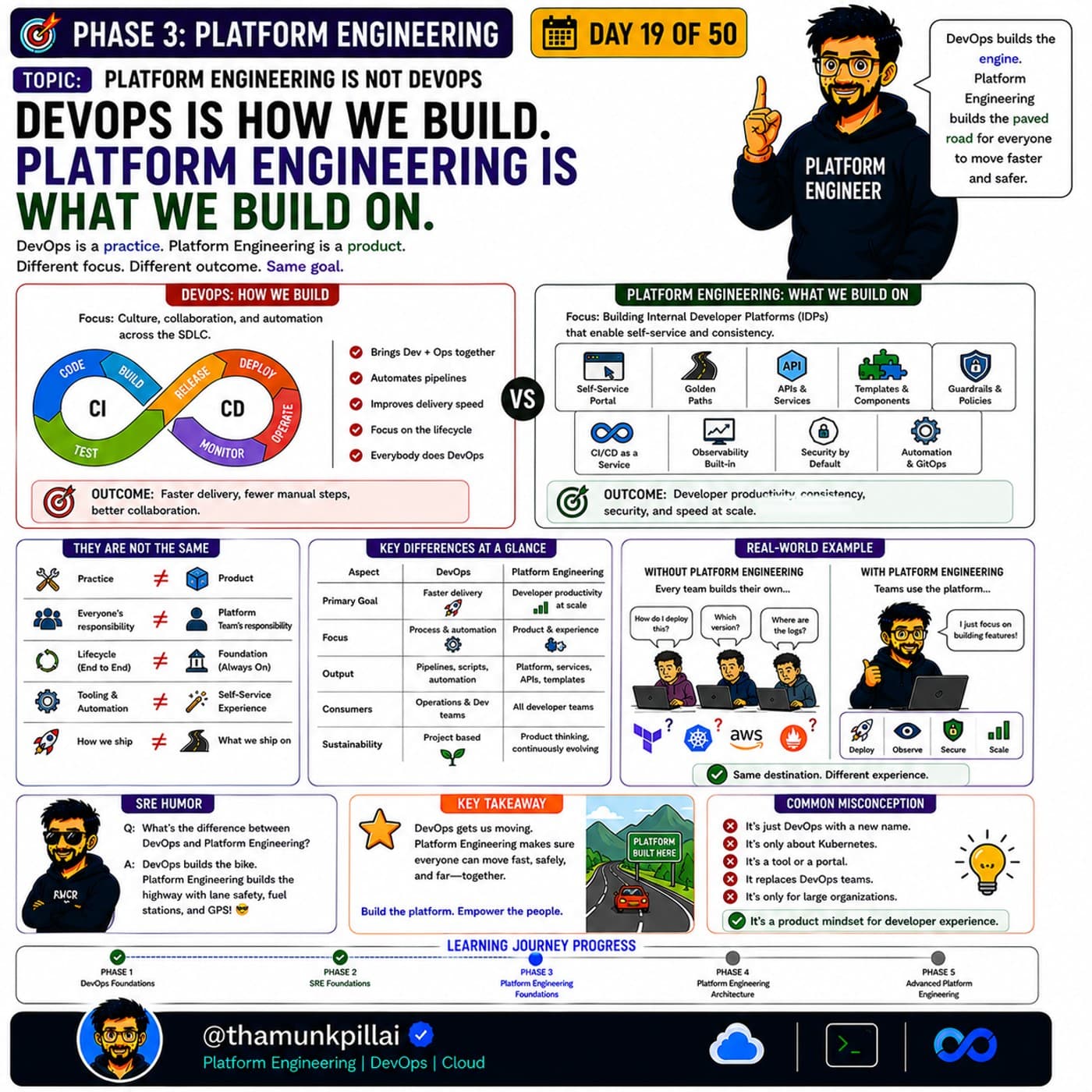
This is where the series named its actual subject: platform engineering as a product discipline, distinct from DevOps as a practice (Days 18–19). Days 20 through 27 built the case piece by piece — platform teams exist to remove friction, not add layers (Day 20); a platform has to be run as a product, not delivered once (Day 21); developer experience is the lens for whether any of it worked (Day 22); cognitive load is the mechanism it's actually fighting (Day 23); self-service is the delivery model (Day 24); golden paths are the opinionated shape of what gets delivered (Day 25); guardrails, not gates, are what keeps that safe without making it slow (Day 26). Day 27 pulled all of it together into the artifact the whole phase was building toward: the Internal Developer Platform.
Phase 4 — Platform Engineering Architecture (Days 28–35)
Phase 4 took the IDP apart layer by layer — developer experience, platform services, platform capabilities, and the infrastructure foundation underneath (Day 28) — then made each layer concrete: Kubernetes as the actual foundation most platforms are built on (Day 30), platform APIs as the contract between developers and everything underneath (Day 31), and observability applied to the platform itself, not just the applications running on it (Day 32). The back half of the phase looked at what AI adds on top of that architecture: AI-powered platform engineering (Day 33), AI-SRE specifically for reliability work (Day 34), and the Model Context Protocol as the standardized way an AI system actually gets live access to all of it (Day 35) — closing with GitOps (Day 29) as the mechanism that makes the automation in this whole stack trustworthy, continuously reconciling live state against what Git says it should be.
Phase 5 — Advanced Platform Engineering (Days 36–49)
The last phase moved from architecture to the practice of actually running a mature platform organization. Platform product management (Day 36) opened it, followed by the two halves of measuring whether any of this is working: developer productivity (Day 37) and platform adoption specifically (Day 38) — because excellent metrics from your happiest users don't mean anything if most teams never adopted the platform at all. Build versus buy (Day 39) and FinOps (Day 40) covered the strategic and financial discipline a mature platform needs, and security as policy-as-code (Day 41) extended the guardrails-not-gates argument from Day 26 into security specifically. Multi-cloud (Day 42) and secrets and identity at scale (Day 43) tackled the harder versions of problems the series had already solved for a single cloud. AI agents got a full arc of their own — what they do (Day 44), what a platform needs before it can trust them with real access (Day 48) — bracketing anti-patterns (Day 45), a career roadmap (Day 46), and a maturity model for judging a platform honestly (Day 47). Day 49 closed with the question underneath the whole fifty days: who can actually do this work — and the answer was mindset, not credentials.
The one thread running through all fifty days
Every phase in this series is an answer to a version of the same question, asked at a different altitude. Phase 1 asked it about code and infrastructure. Phase 2 asked it about reliability. Phase 3 and 4 asked it about the platform itself. Phase 5 asked it about the organization running that platform. The question, stated once, plainly: what does it take for the gap between building something and running it well to actually close — permanently, for everyone on the team, not just for whoever happens to be paying the most attention this week?
The answer this series arrived at, piece by piece, was never a single tool. It was a stack of deliberate decisions — code as the source of truth, reliability engineered rather than hoped for, a platform built as a product with real users, architecture that puts complexity in the right layer, and a team that measures whether any of it actually landed. None of those decisions are exotic. All of them are available to a team willing to make them on purpose, starting wherever they already are.
If you're arriving here first
Day 1 — "What DevOps Actually Is" — is still the right place to start. Everything in this recap builds in order, and the series was written to be read that way: one day, one idea, each one assuming the last one landed.
Thanks for reading fifty days of this. If any single day changed how you think about a system you're responsible for, it did its job.