By day 3 of most DevOps transformations, someone has said out loud: "great, so every team builds their own CI/CD, their own Kubernetes setup, their own secrets management, their own observability stack." And by day 30, ten teams have built ten slightly different, all partially broken versions of the same thing, and none of them are particularly good at operating any of it, because none of them are infrastructure specialists — they're specialists in whatever the product actually does.
That's the gap platform engineering exists to close. If DevOps says "the team that builds it should run it," platform engineering asks the obvious follow-up: what does that team actually need so that running it doesn't consume half their capacity?
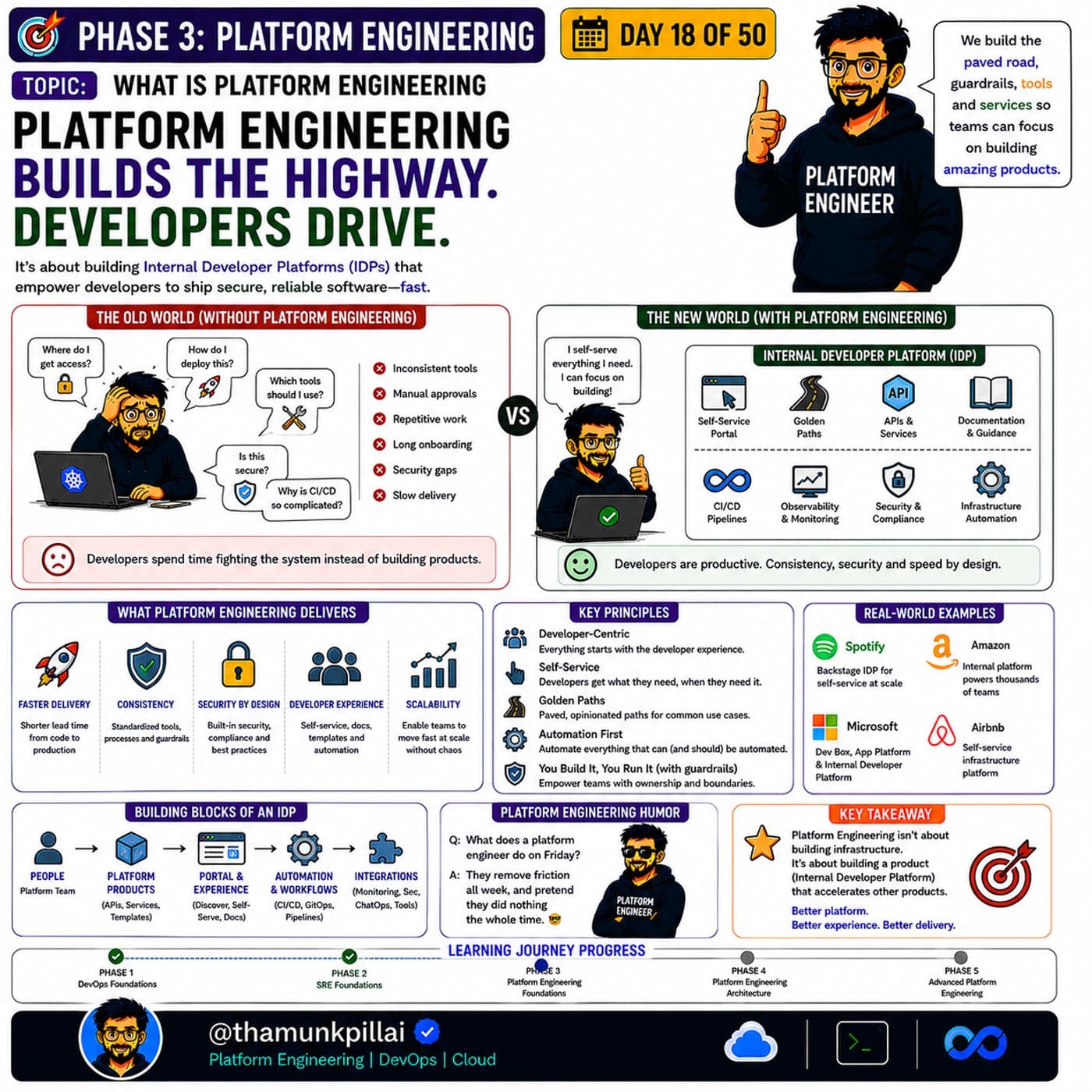
The old world, without a platform
Picture a developer who wants to ship a new service. Before they write a line of business logic, they're answering questions that have nothing to do with the problem they're solving: Where do I get access? How do I deploy this? Which of the four logging libraries are we supposed to use this quarter? Is this configuration secure? Why is the CI pipeline so slow?
None of that is the developer's job. It's infrastructure work that happens to be blocking product work, and in most organizations without a platform team, it gets solved the same way every time — badly, individually, per team, per service, forever.
Warning
The cost here isn't just developer time. It's inconsistency. Ten teams solving the same infrastructure problem independently means ten different security postures, ten different failure modes, and ten different things for whoever's on call to learn before they can help.
What a platform actually provides
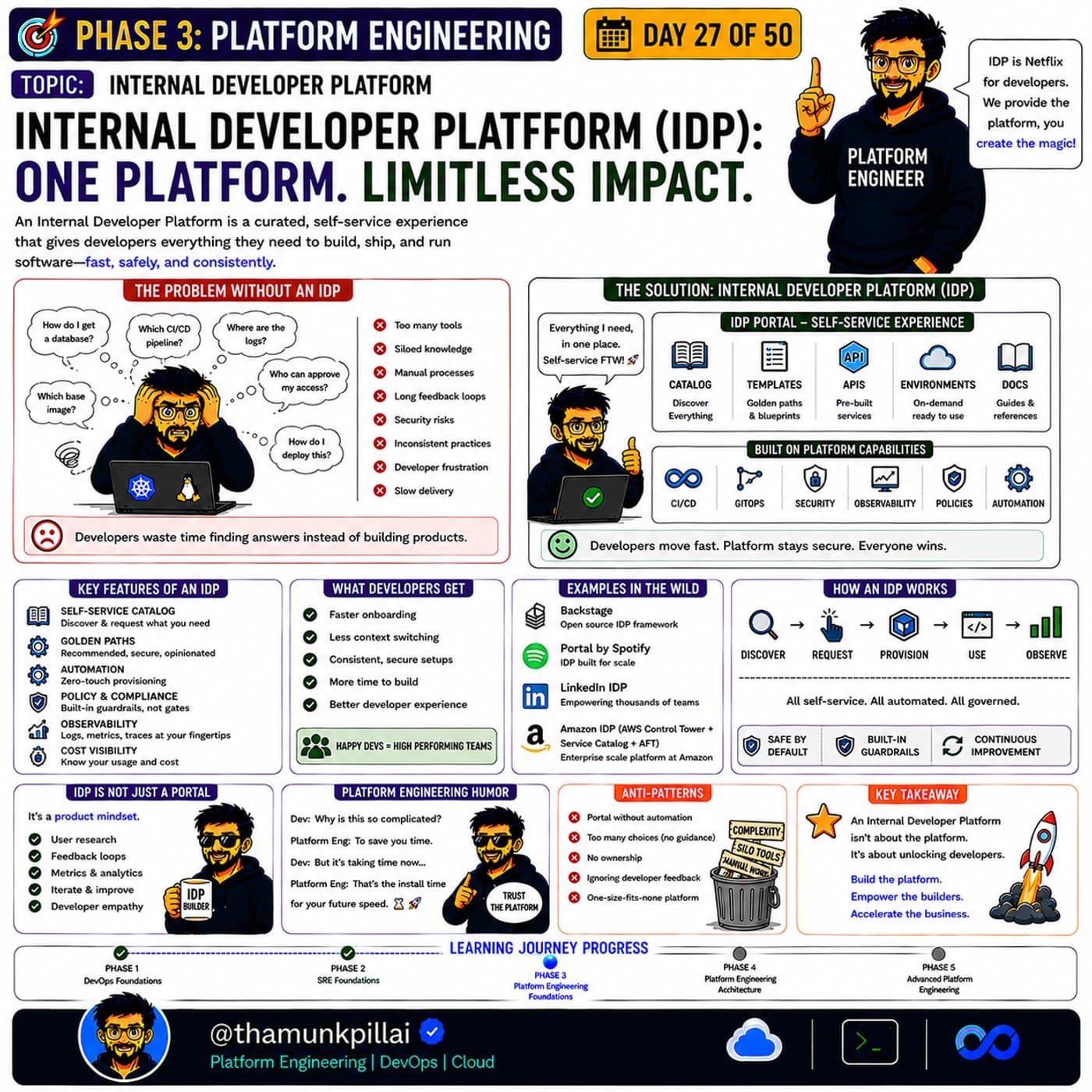
An internal developer platform (IDP) is the self-service layer that sits between "developers who want to ship" and "the underlying infrastructure that makes shipping possible." Concretely, that's usually:
- A self-service portal or API — request a database, a new service scaffold, an environment, without filing a ticket and waiting.
- Golden paths — an opinionated, pre-approved route from
git initto production traffic, so most teams never have to make the infrastructure decisions from scratch. - CI/CD as a service — pipelines that are configured once by the platform team and consumed by application teams, not hand-rolled per repo.
- Observability and security built in — a new service gets dashboards, tracing, and baseline security posture automatically, not as a follow-up task someone forgets.
The point of all of this isn't control for its own sake. It's that the boring 80% of decisions — how do we deploy, how do we monitor, how do we secure this — get made once, well, by people who specialize in making them, so that application teams spend their judgment on the 20% that's actually specific to their product.
Platform engineering is not DevOps with a rename
This is worth being blunt about, because the two get flattened together constantly. DevOps is a practice — culture, collaboration, and automation across the software lifecycle. It's everyone's responsibility, and it doesn't produce an artifact you can point to.
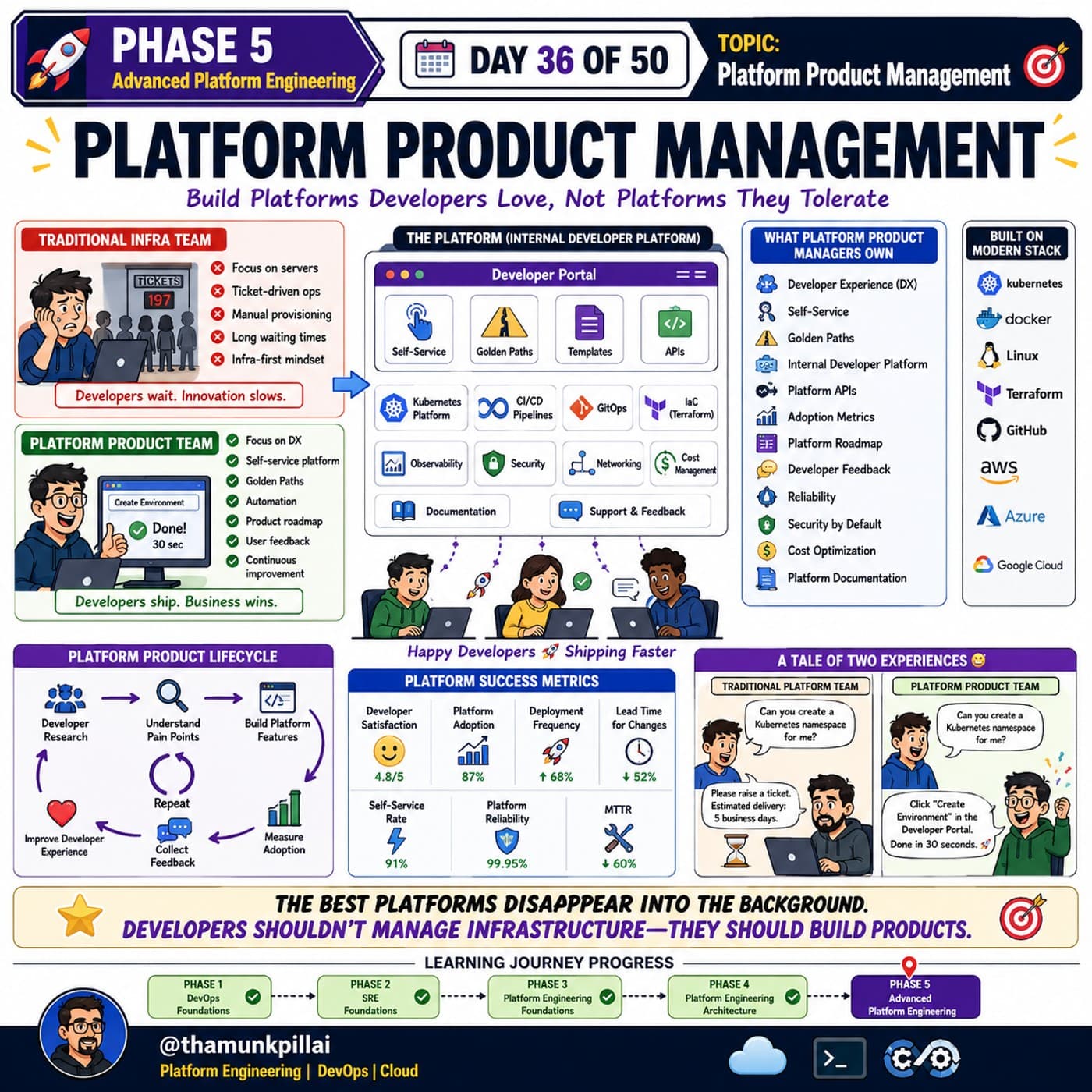
Platform engineering is a product discipline. It has users (your developers), it ships a thing (the platform), and — critically — it can fail the way any product fails: low adoption, users routing around it, a roadmap nobody asked for. The platform team's job is treating the IDP with the same product rigor a good product team applies to a customer-facing feature, complete with user interviews, adoption metrics, and the willingness to be told a feature isn't wanted.
The tell that separates the two
DevOps done well is invisible — it's just how the team operates. A platform done well is visible — developers can point to the portal, the golden path, the docs, and say "that's what lets me move fast."
Real-world examples aren't hypothetical
Spotify's Backstage started as an internal developer portal before it became one of the most widely adopted open-source platform-engineering tools in the industry. Airbnb, Microsoft, and Netflix all run internal platform teams for the same underlying reason: past a certain org size, letting every team independently solve infrastructure isn't a cultural choice, it's a tax that compounds every quarter you don't address it.
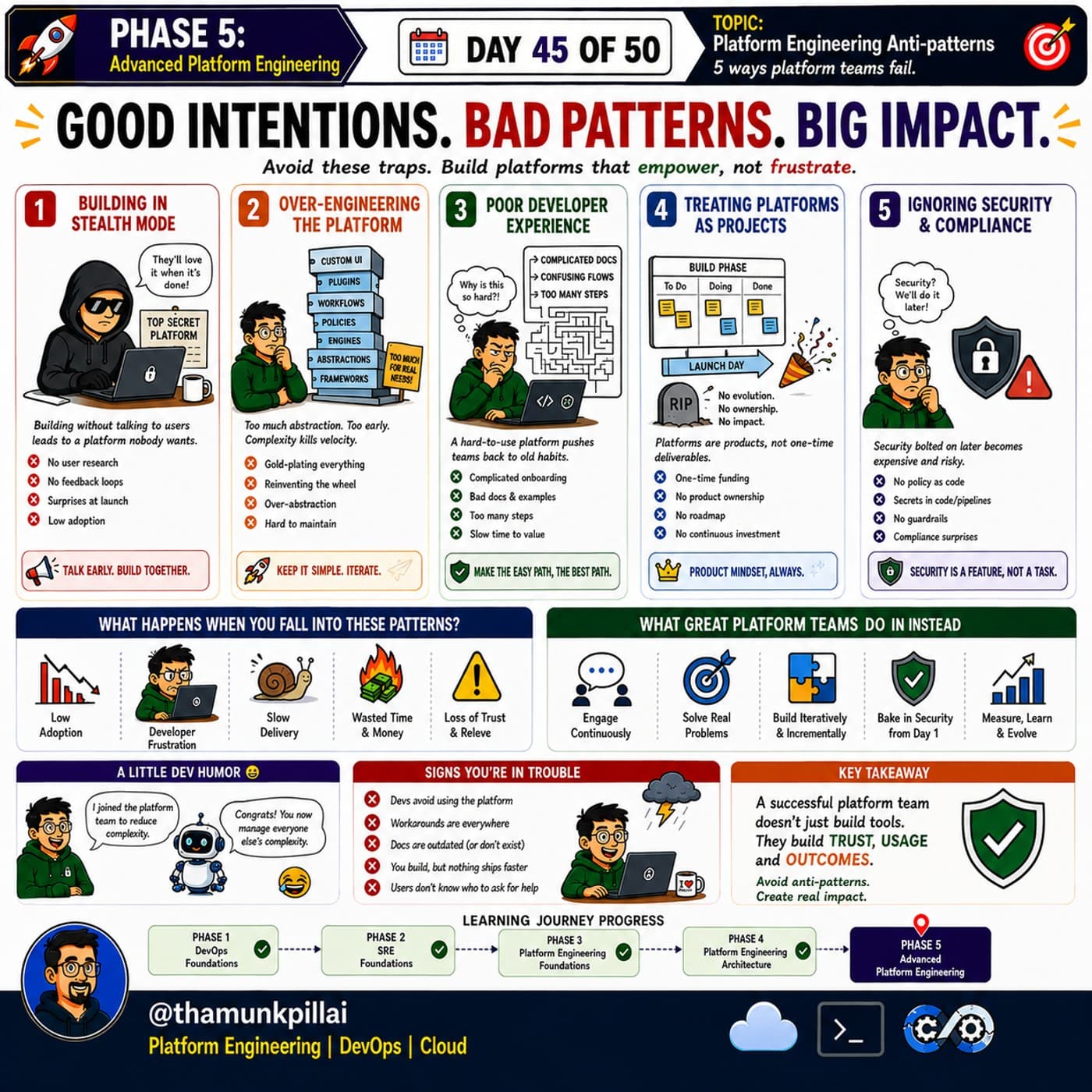
The uncomfortable part is that a platform is genuinely hard to get right, and an easy way to get it wrong is building what the platform team finds interesting rather than what's actually blocking application teams. That failure mode — and the golden-path discipline that avoids it — is what day 25 of this series covers in depth.
For now, the compact version: DevOps is the practice everyone on a team should follow. Platform engineering is the product that makes following it something other than a full-time infrastructure job.