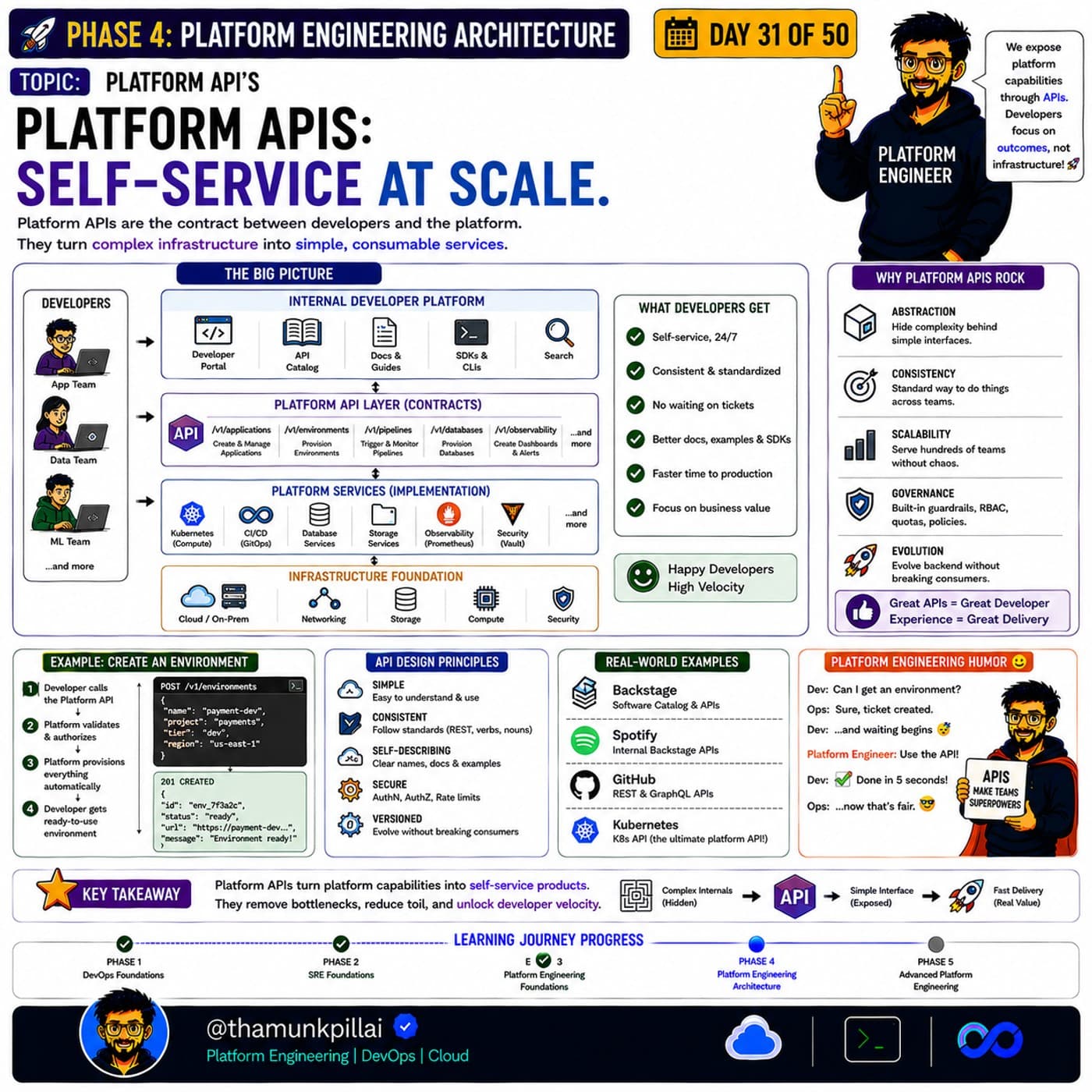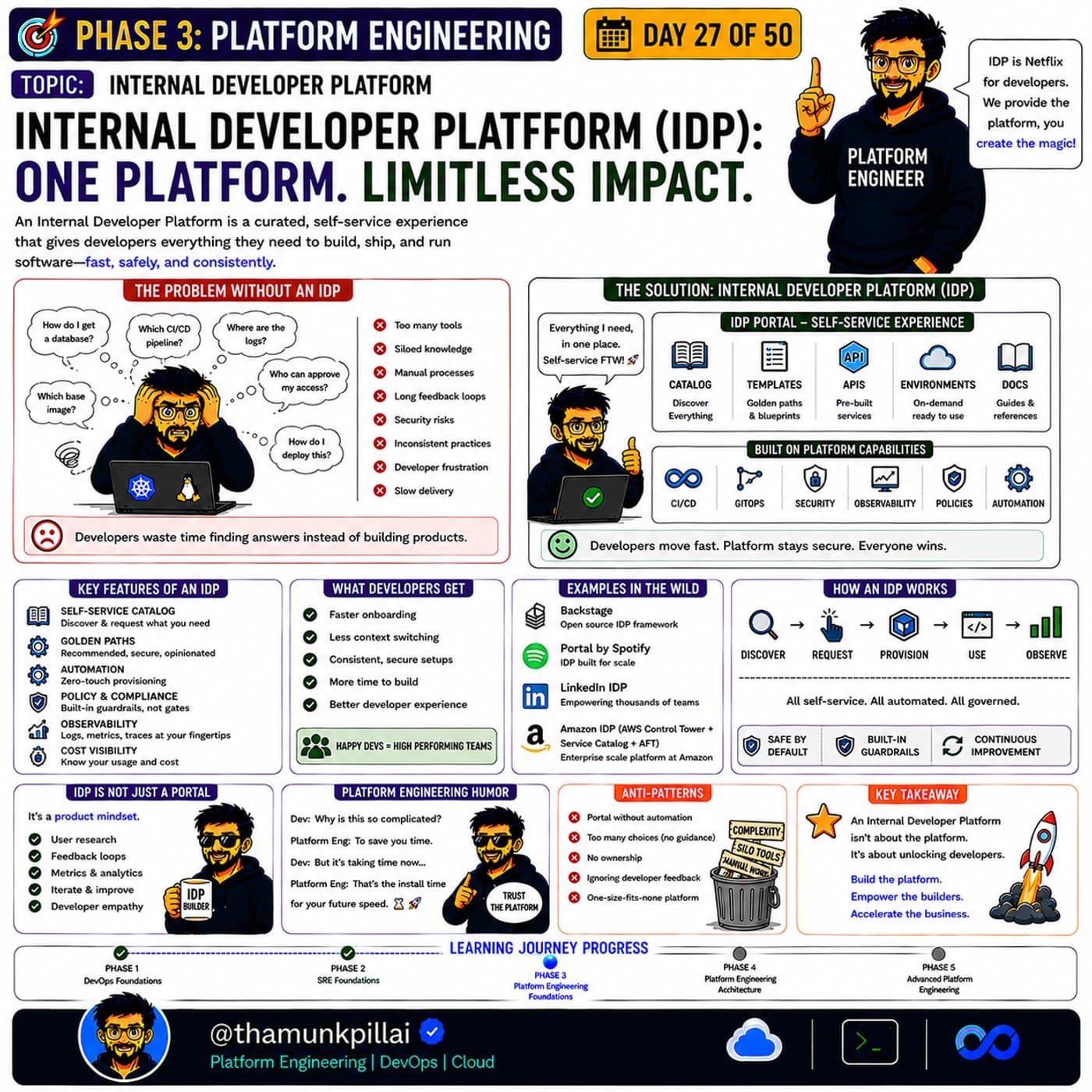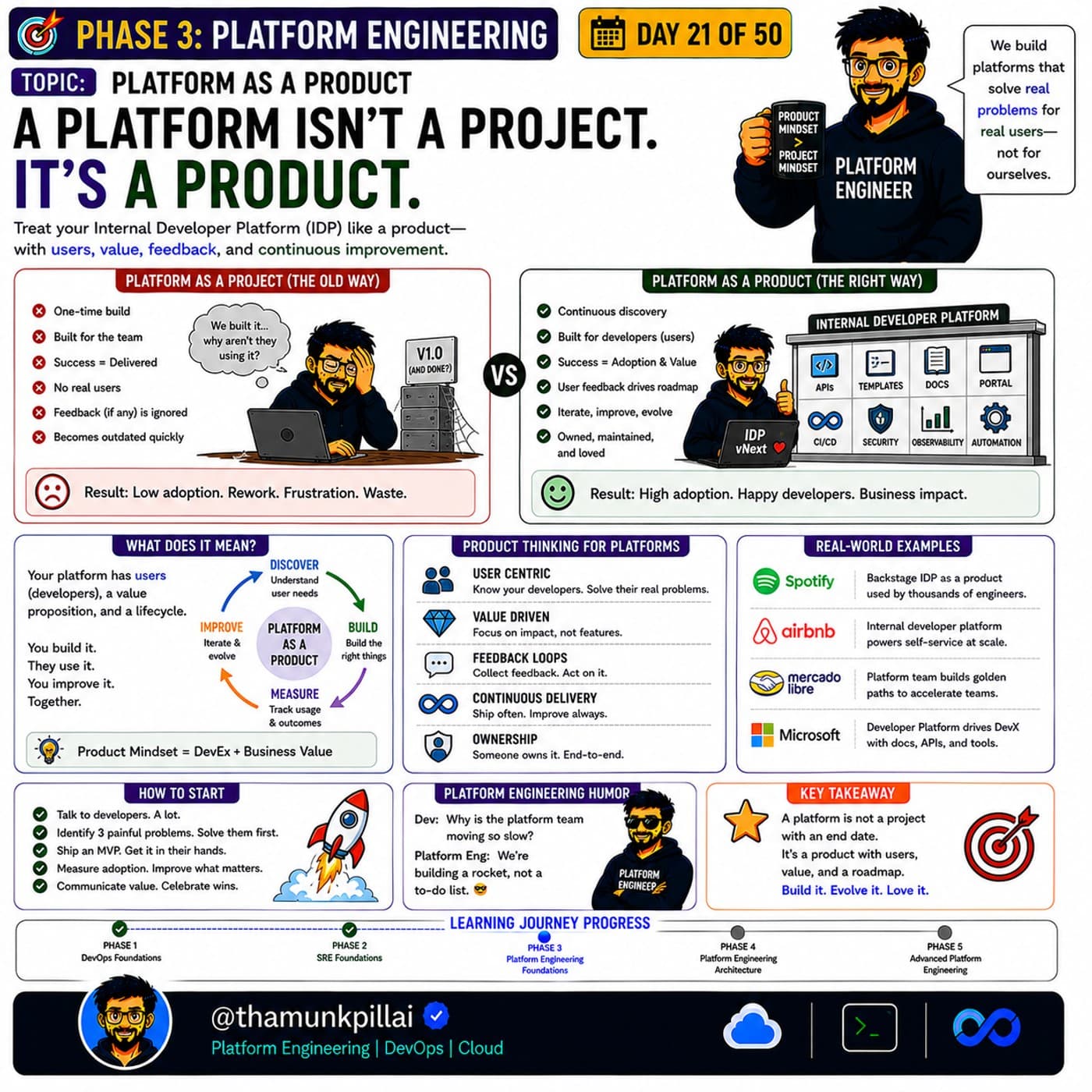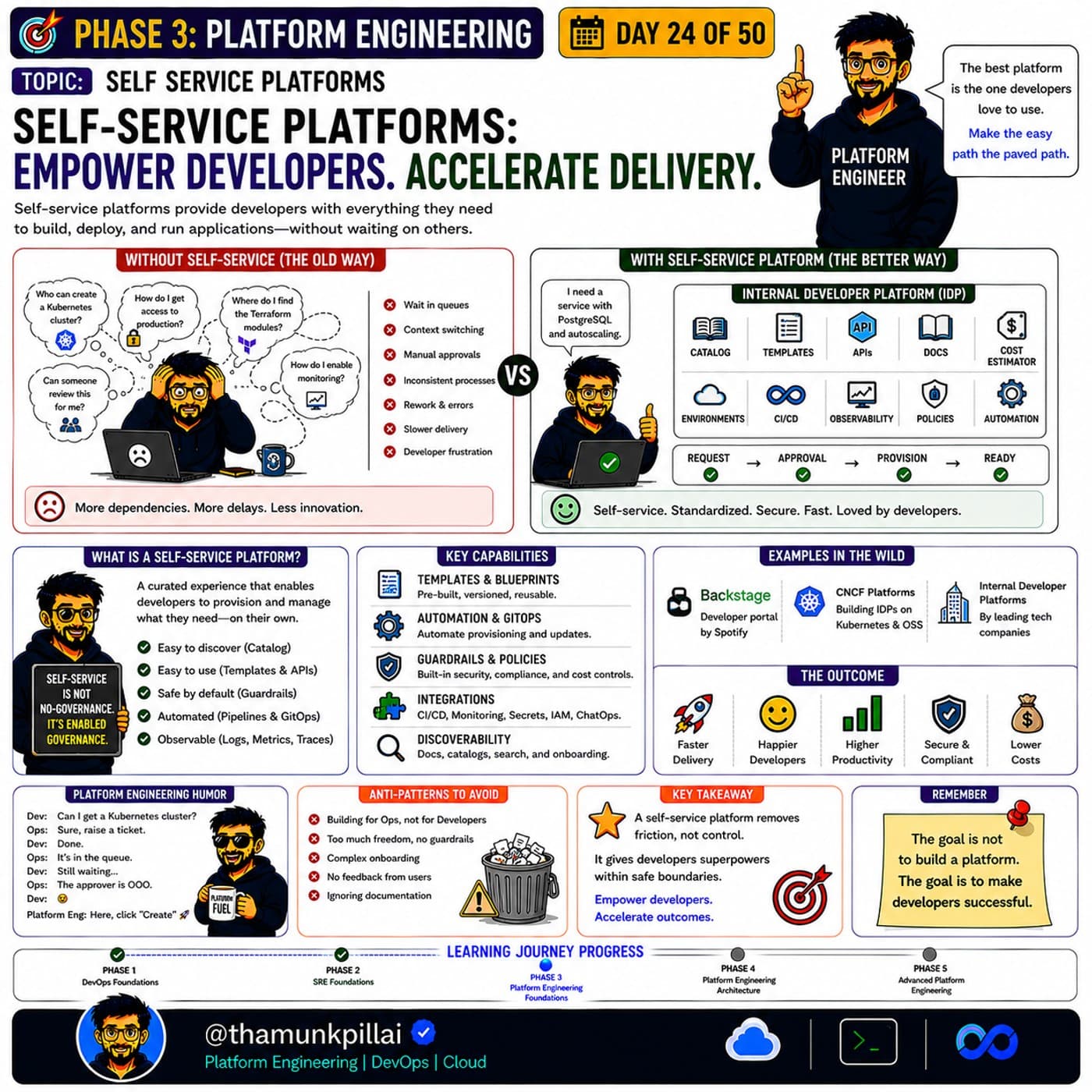
"Can I get a Kubernetes cluster?" "Sure, raise a ticket." That exchange, and every variant of it — a database, an environment, an access grant — is the default operating model at organizations without self-service infrastructure, and it's worth being precise about what it actually costs: not just the wait itself, but everything downstream of the wait. Developers batch up unrelated work while blocked. Context gets lost between the request and the eventual approval. And the approver, usually a platform or ops engineer, spends their day processing routine requests instead of improving the thing being requested.
A self-service platform is the alternative: a curated experience that lets developers provision and manage what they need themselves, safely, without a human in the loop for the routine cases.
Warning
The instinctive objection is "but then developers can just do anything" — and it's wrong in a specific, important way. Self-service is not the absence of governance. It's enabled governance: the rules get enforced automatically, every time, instead of manually, inconsistently, by whoever happens to review the ticket that day.
The request lifecycle, before and after
Before (manual):
  Request → Wait in queue → Manual review → Back-and-forth → Provision → Ready
  (hours to days, and every step can silently stall)

After (self-service):
  Request → Automated policy check → Provision → Ready
  (minutes, and the policy check is the exact same rule, every time)
The "automated policy check" step is doing the real work here, and it's worth naming directly: it's not a weaker version of manual review, it's a more consistent one. A human reviewer approving twenty requests a day will apply the rules slightly differently depending on time of day, workload, and who's asking. A policy check enforces the identical rule every single time, with a clear, logged reason when it says no.
What has to be true for self-service to actually work
| Capability | What it replaces |
|---|---|
| Catalog | "What's even available to request?" |
| Templates & blueprints | Rebuilding the same service pattern from scratch |
| APIs | Manual provisioning steps done by hand |
| Guardrails & policies | A human manually checking for compliance |
| Automation & GitOps | Someone running commands by hand after approval |
| Observability | Finding out something's wrong from a user, not a dashboard |
| Cost visibility | Discovering the bill at the end of the month |
Every row on the left only works as self-service if it's also safe by default — a catalog of things developers can break just as easily as a manual process, just faster, isn't progress. This is why guardrails and policy enforcement aren't a separate initiative bolted onto self-service; they're the thing that makes removing the human gate defensible in the first place.
Real systems, same underlying claim
Backstage (Spotify's developer portal), the CNCF ecosystem's various IDP tooling built on Kubernetes, and most large tech companies' internal developer platforms all converge on the identical shape: a catalog developers browse, templates they instantiate, and automated guardrails that enforce policy without a human reviewing every request. None of them removed governance to get speed. They automated governance to get both.
A useful gut-check for any self-service feature
"Self-service is not no-governance. It's enabled governance." If a proposed self-service feature can't state clearly what guardrail replaces the human reviewer it's removing, it's not ready to ship — it's just moving the risk from "slow but checked" to "fast and unchecked."
Why removing the wait is worth this much engineering effort
The measurable outcomes organizations report from real self-service platforms — faster delivery, happier developers, higher productivity, better security and compliance posture, lower cost — all trace back to the same root cause: waiting is expensive in ways that don't show up as a line item. A developer blocked on infrastructure doesn't just lose the wait time; they lose the momentum and context that made the task fast in the first place, and they often start something else in the meantime that competes for the same attention once the original request finally clears.
The common failure mode worth naming directly: building for ops, not for developers — a self-service portal designed around what's easy for the platform team to expose, rather than what developers actually need to request, with no guardrails and no feedback loop from the people using it. That produces a portal nobody uses, which is worse than no portal at all, because it consumed real engineering effort to build.
Tomorrow's article covers the specific mechanism that makes self-service requests fast and correct by default: golden paths — the opinionated, pre-approved route from an idea to production that removes the "which way is right" decision before a developer ever has to make it.