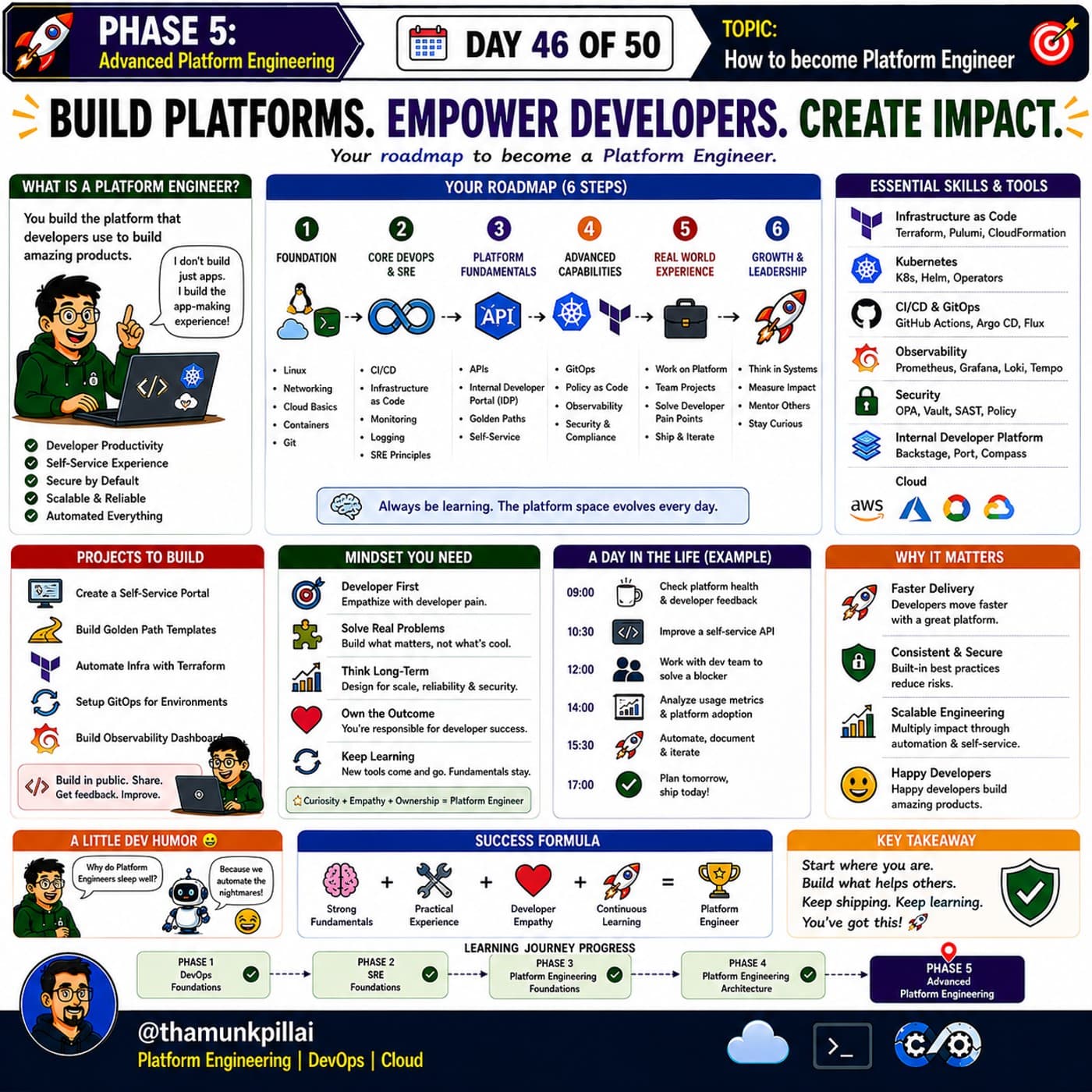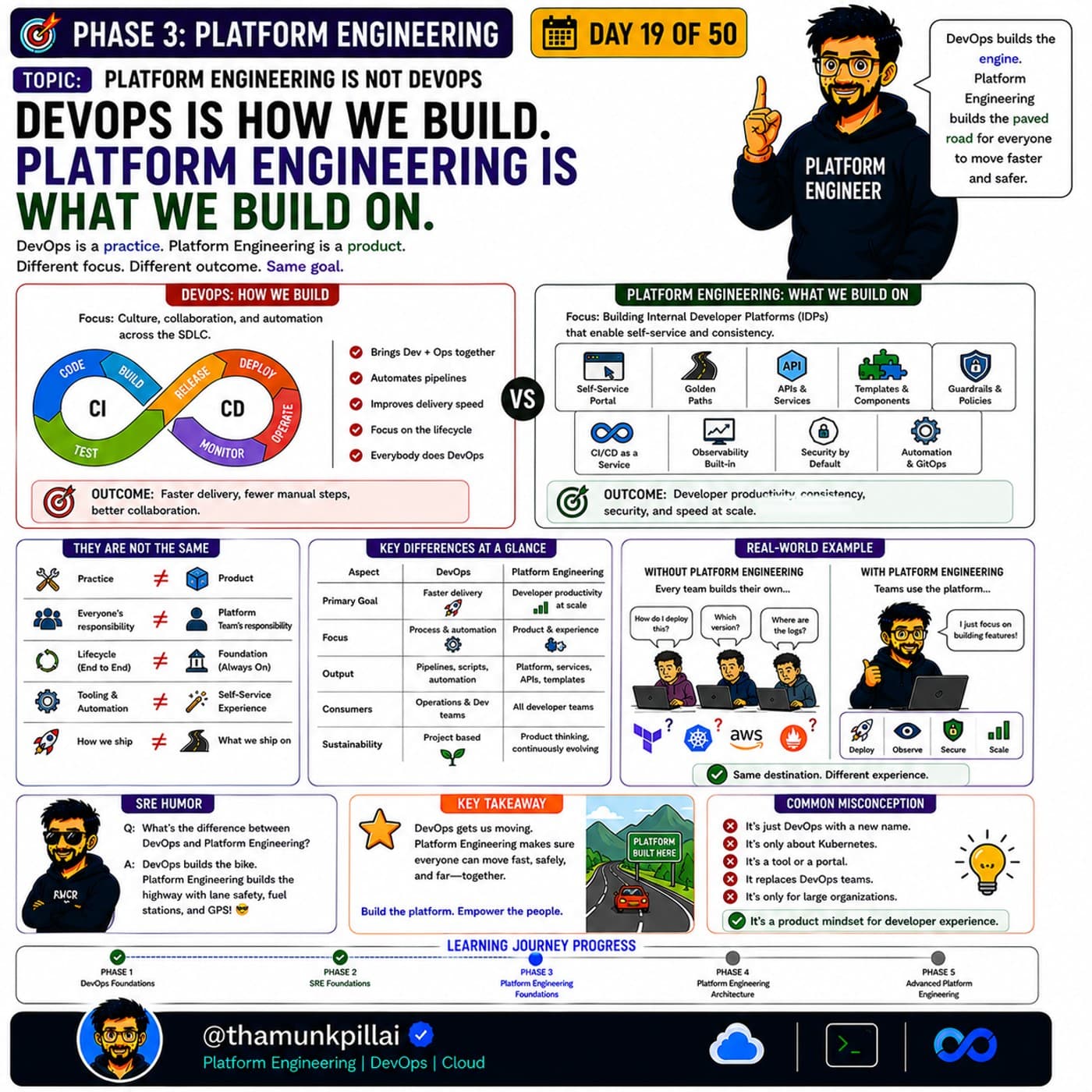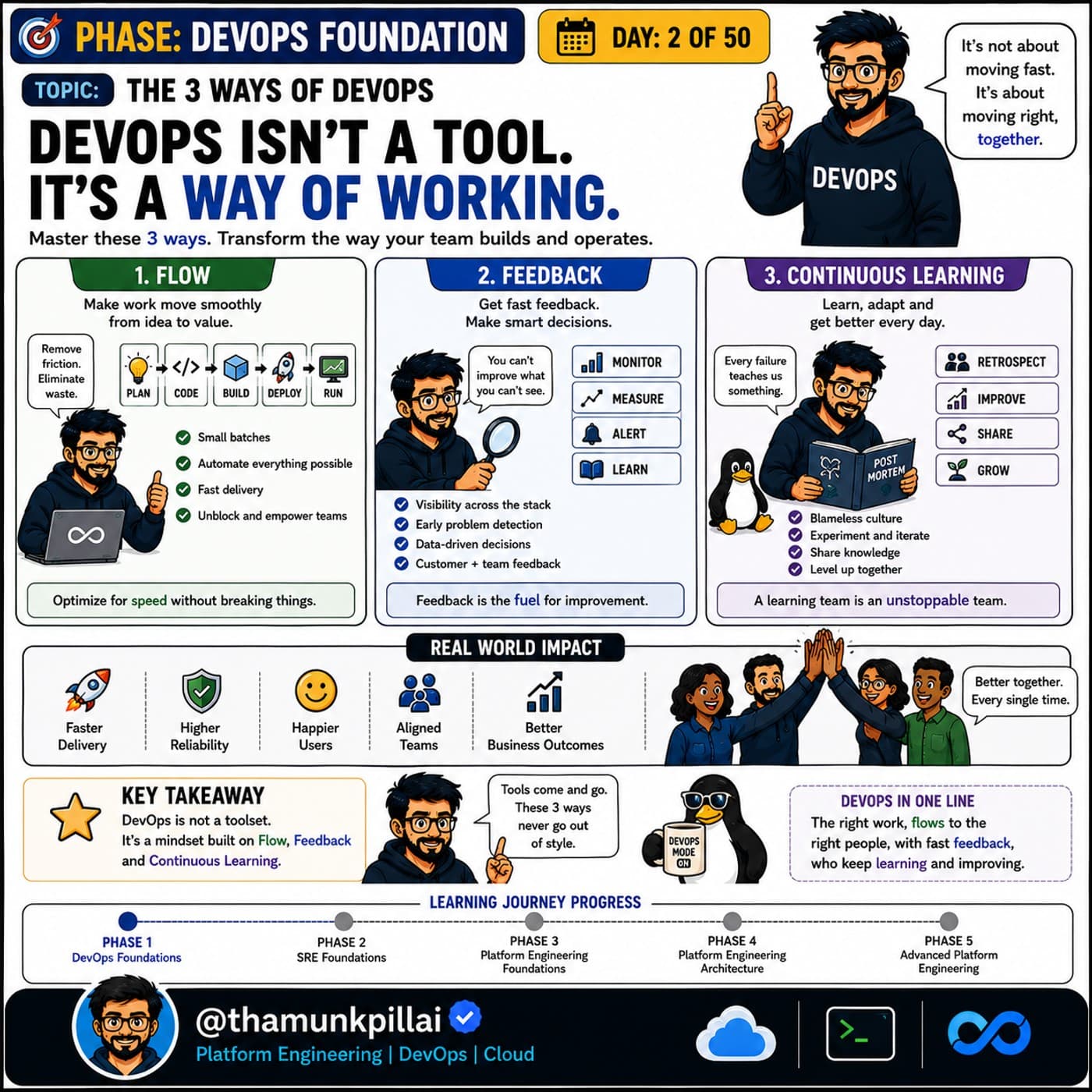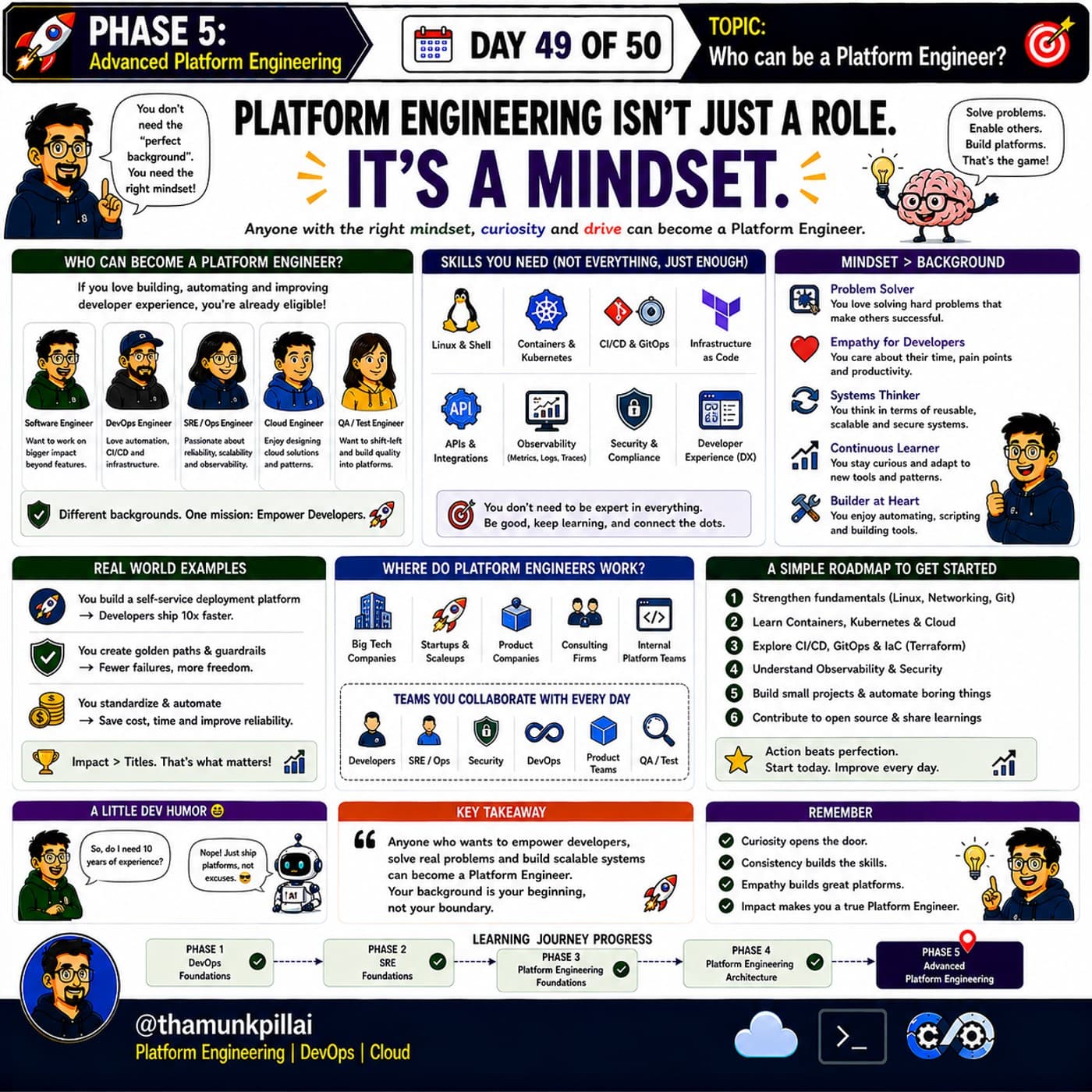
Forty-eight days of this series have covered Kubernetes, GitOps, policy as code, FinOps, AI agents, and a six-step career roadmap. None of that answers the question this article exists to answer directly: who is this actually for? The honest answer is broader than the roadmap alone suggests — "you don't need the perfect background. You need the right mindset." Anyone with the right mindset, curiosity, and drive can become a platform engineer, regardless of which door they walk in from.
Note
"Solve problems. Enable others. Build platforms. That's the game." Notice what's absent from that sentence: a specific degree, a specific prior title, a specific number of years with a specific tool. The job is defined by an outcome — developers succeed because of what you built — not by a credential.
Who's already eligible, from where they already stand
Software Engineer  → wants to work on bigger impact beyond features
DevOps Engineer    → loves automation, CI/CD, and infrastructure
SRE / Ops Engineer → passionate about reliability, scalability, observability
Cloud Engineer     → enjoys designing cloud solutions and patterns
QA / Test Engineer → wants to shift-left and build quality into platforms
Five different starting points, five different existing skill sets — and every one of them maps onto a phase this series has already covered. A QA engineer's shift-left instincts are exactly Day 8's argument. A cloud engineer's pattern sense is exactly what Day 30 and Day 42 need. None of these five is the "correct" background; they're five equally valid on-ramps into the same six-step roadmap Day 46 laid out.
The skills, framed as "enough," not "everything"
Linux & Shell · Containers & Kubernetes · CI/CD & GitOps · Infrastructure as Code
APIs & Integrations · Observability (Metrics, Logs, Traces) · Security & Compliance
Developer Experience (DX)
"You don't need to be an expert in everything. Be good, keep learning, and connect the dots." That instruction matters because the alternative belief — that you need mastery of every item on that list before you're qualified to start — is exactly the kind of over-engineering-by-self-doubt version of Day 45's anti-pattern, applied to a career instead of a platform.
Mindset over background, stated as five traits
| Trait | What it looks like |
|---|---|
| Problem solver | You love solving hard problems that make others successful |
| Empathy for developers | You care about their time, pain points, and productivity |
| Systems thinker | You think in terms of reusable, scalable systems |
| Continuous learner | You stay curious and adapt to new tools and patterns |
| Builder at heart | You enjoy automating, scripting, and building tools |
Every one of these traits has shown up as an implicit theme across this entire series without being named directly until now — empathy for developers is Day 22's developer experience argument; systems thinking is Day 28's four-layer architecture; being a continuous learner is the honest answer to why this series exists as fifty separate days instead of one document.
A roadmap that starts wherever you already are
1. Strengthen fundamentals (Linux, Networking, Git)
2. Learn Containers, Kubernetes & Cloud
3. Explore CI/CD, GitOps & IaC (Terraform)
4. Understand Observability & Security
5. Build small projects & automate boring things
6. Contribute to open source & share learnings
"Action beats perfection. Start today. Improve every day." This is the same six-step shape as Day 46's roadmap, compressed to the version that matters for someone deciding whether to start at all: the fundamentals come first regardless of background, and the fastest way to progress past them is building something real, even small, rather than waiting to feel fully ready.
The line worth remembering from this entire series
"Anyone who wants to empower developers, solve real problems, and build scalable systems can become a Platform Engineer. Your background is your beginning, not your boundary." Every article in this fifty-day series — from Day 1's definition of DevOps to today — has been building toward exactly this: platform engineering is a discipline defined by what you do for the developers depending on you, not by the title on your badge before you started doing it.
Where this series has been heading
Impact, not titles, is what matters — "different backgrounds, one mission: empower developers." That's the note this fifty-day arc closes on: DevOps culture, SRE discipline, platform architecture, product thinking, and now AI-assisted operations are all just increasingly sophisticated answers to one original question from Day 1 — how do you close the gap between building software and running it well. Whoever's asking that question seriously, from whatever seat they're asking it from, already has what it takes to start.