Day 21 of this series made the argument that a platform is a product, not a project. Today opens Phase 5 — Advanced Platform Engineering — by making that argument operational: platform product management is the actual job of running a platform the way a product team runs anything else, with a roadmap, adoption metrics, and a lifecycle that never really finishes.
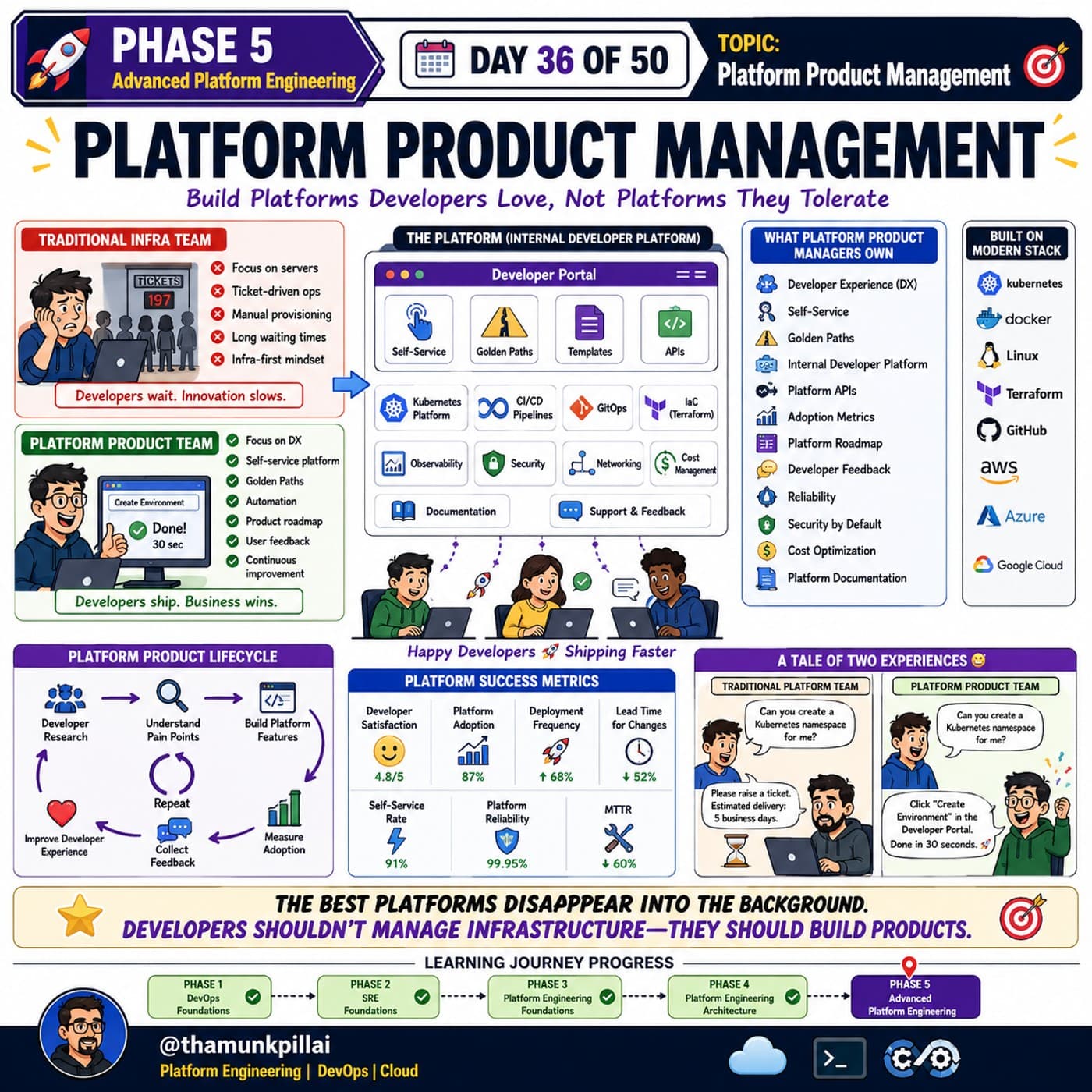
The clearest way to see why this job needs to exist is the contrast between two teams solving the identical request. A developer asks, "can you create a Kubernetes namespace for me?" A traditional infrastructure team says: please raise a ticket, estimated delivery five business days. A platform product team says: click "Create Environment" in the developer portal, done in thirty seconds. Same request, same underlying infrastructure — the only thing that changed is whether someone owns the developer's experience of getting it.
Note
"The best platforms disappear into the background. Developers shouldn't manage infrastructure — they should build products." That's the target platform product management is aimed at, and it's worth noticing it's a statement about developer experience, not about infrastructure capability. A platform can be technically excellent and still fail this bar if using it still feels like managing infrastructure.
What a platform product manager actually owns
Developer Experience (DX)      Adoption Metrics
Self-Service                    Platform Roadmap
Golden Paths                    Developer Feedback
Internal Developer Platform     Reliability
Platform APIs                   Security by Default
                                 Cost Optimization
                                 Platform Documentation
Every item on that list has appeared somewhere earlier in this series — self-service (Day 24), golden paths (Day 25), platform APIs (Day 31), observability-driven reliability (Day 32), security as policy (coming tomorrow), FinOps (Day 40). Platform product management isn't a new capability alongside those; it's the ownership role that keeps all of them coherent, prioritized, and pointed at what developers actually need rather than what's individually interesting to build.
The lifecycle, and why it has no end state
Developer Research → Understand Pain Points → Build Platform Features
        ↑                                              ↓
Improve Developer Experience ← Collect Feedback ← Measure Adoption
This loop is identical in shape to Day 21's product lifecycle, and deliberately so — the point is that a platform never reaches "done." A platform team that ships a feature and moves on without measuring adoption or collecting feedback has quietly reverted to running a project, even if nobody called it that.
The numbers a platform product manager actually watches
| Metric | What it tells you |
|---|---|
| Developer satisfaction | Is the platform something people want to use? |
| Platform adoption | Are teams actually on it, or working around it? |
| Deployment frequency | Is the platform accelerating shipping or slowing it? |
| Lead time for changes | How fast does an idea become production traffic? |
| Self-service rate | How much is resolved without a human in the loop? |
| Platform reliability | Is the platform itself trustworthy enough to depend on? |
| MTTR | When the platform breaks, how fast does it recover? |
None of these are vanity metrics collected for a slide deck — each one directly answers a question a real product manager would ask about any product with users. "87% adoption, 4.8/5 satisfaction, 68% faster deployment frequency, 60% lower MTTR" is a genuinely different conversation with leadership than "we shipped the platform," because it's evidence the platform is actually working, not just that it exists.
The tale of two teams, told twice
This series has now made the same before/after comparison at three different altitudes: DevOps versus siloed delivery (Day 3), self-service versus ticket queues (Day 24), and today, traditional infra teams versus platform product teams. It's the same shape every time because it's the same underlying failure mode — a human gate where automation and ownership could remove the wait entirely.
Why this is the right way to open Phase 5
Everything this series covers from here — build-vs-buy decisions, FinOps, security as policy, platform maturity models, how someone actually becomes a platform engineer — is downstream of one question a platform product manager is responsible for answering honestly: is this platform actually serving the developers it exists for? Tomorrow's article gets specific about the first half of measuring that: developer productivity, and why "measure flow, not just output" is a meaningfully different discipline than counting commits.