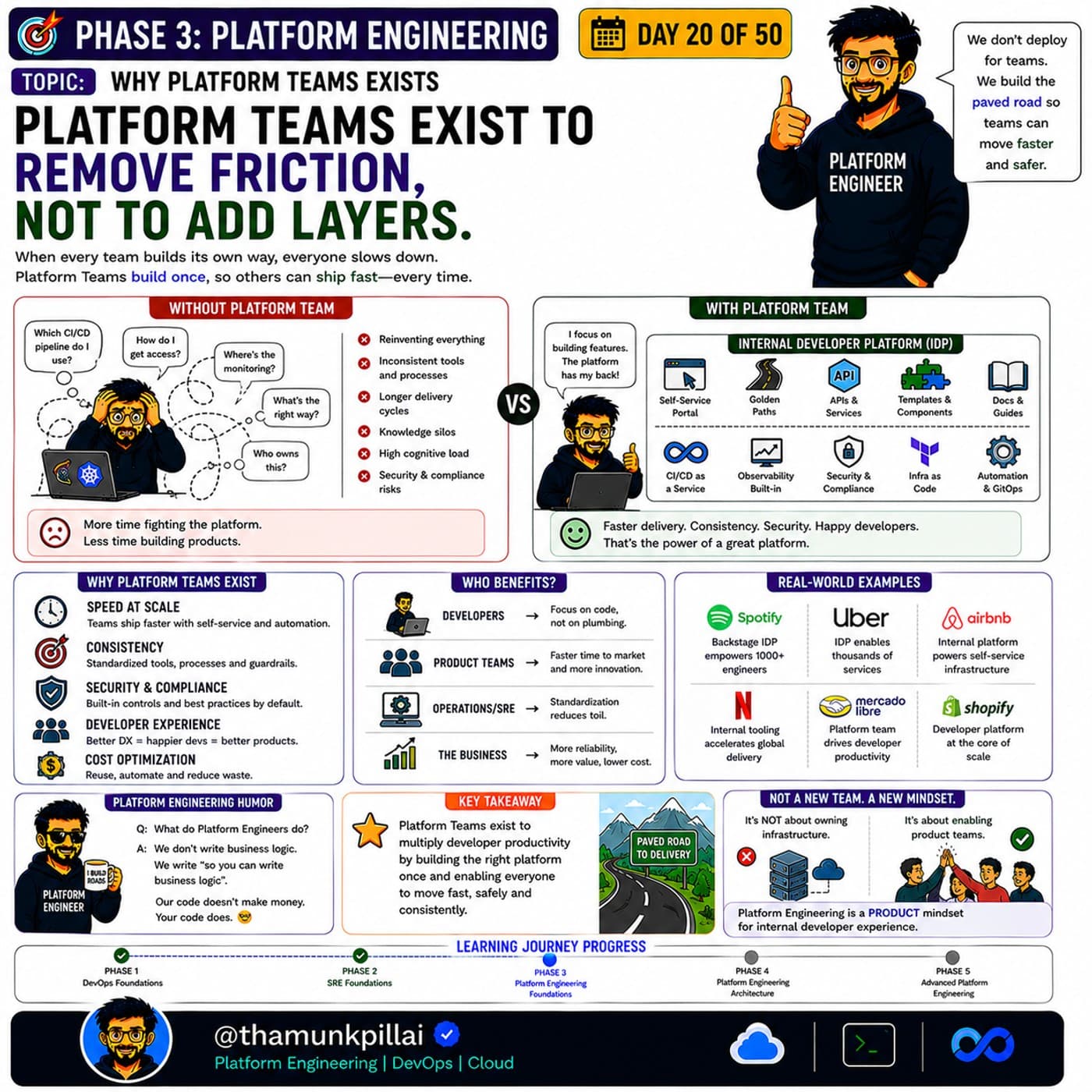
Picture a developer without a platform team behind them. Before they write a line of the feature they were actually hired to build, they're stuck answering questions that have nothing to do with it: which CI/CD pipeline do I use, how do I get access to this environment, where's the right Terraform module, who reviews this, how do I even enable monitoring. Every one of those questions is a small tax, and paid alone, across every team, over and over, they add up to the majority of what should be product engineering time.
That's the specific problem platform teams exist to solve — not "own infrastructure" as an end in itself, but remove exactly that kind of friction so teams can focus on what they're actually there to build.
Without a platform, versus with one
| Without a platform team | With one |
|---|---|
| Every team reinvents CI/CD, access, monitoring | One team builds it once, well |
| Inconsistent tools, inconsistent security posture | Standardized, secure by default |
| "Who owns this?" has no clear answer | Clear ownership, clear support path |
| High cognitive load per developer | Developers focus on code, not plumbing |
| More time fighting the platform | More time building the product |
That "reinvents" row is the actual cost center. Ten teams solving the same infrastructure problem independently doesn't just mean ten times the effort — it means ten different security postures, ten different failure modes, and ten different systems whoever's on call has to learn before they can help. A platform team collapses that into one well-built, well-supported system that every team inherits for free.
What an internal developer platform actually is
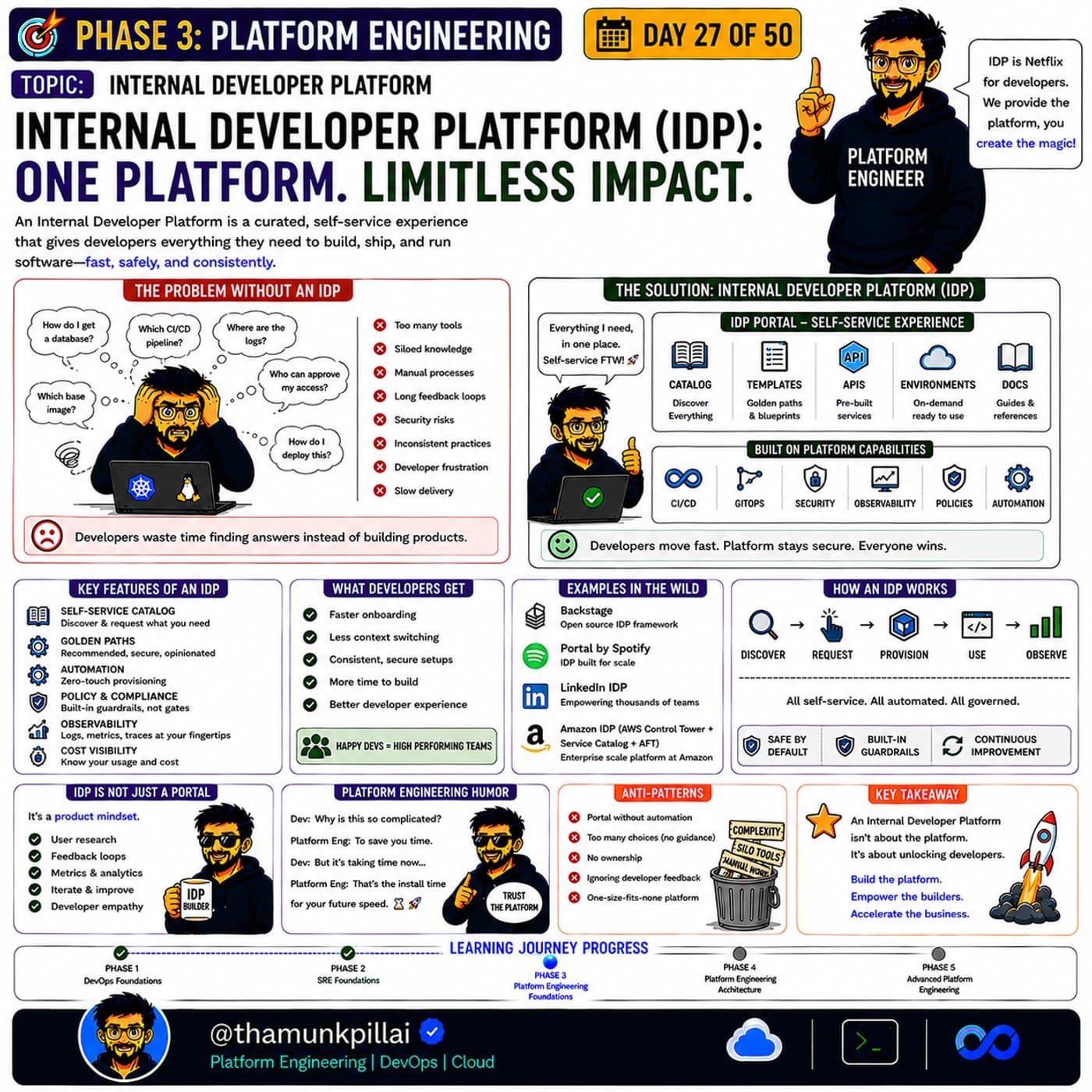
Concretely, an IDP is the self-service layer between "a team that wants to ship" and the infrastructure underneath:
- Self-service portal or API — request a database, an environment, a new service scaffold, without a ticket and a wait.
- Golden paths — an opinionated, pre-approved route from
git initto production, so most teams never make infrastructure decisions from scratch. - CI/CD as a service — pipelines configured once by people who specialize in them, consumed by every application team.
- Observability and security built in — a new service gets dashboards, tracing, and a baseline security posture automatically, not as a follow-up task someone eventually gets to.
- Automation and GitOps underneath it all — the boring, high-stakes plumbing that day 9's "everything as code" argument was setting up for.
Who actually benefits, and why "who benefits" is the argument
| Group | What they get |
|---|---|
| Developers | Focus on code, not infrastructure plumbing |
| Product teams | Faster time to market, more room to innovate |
| Operations / SRE | Standardization reduces toil (Day 12) |
| The business | More reliability, more value, lower cost |
Warning
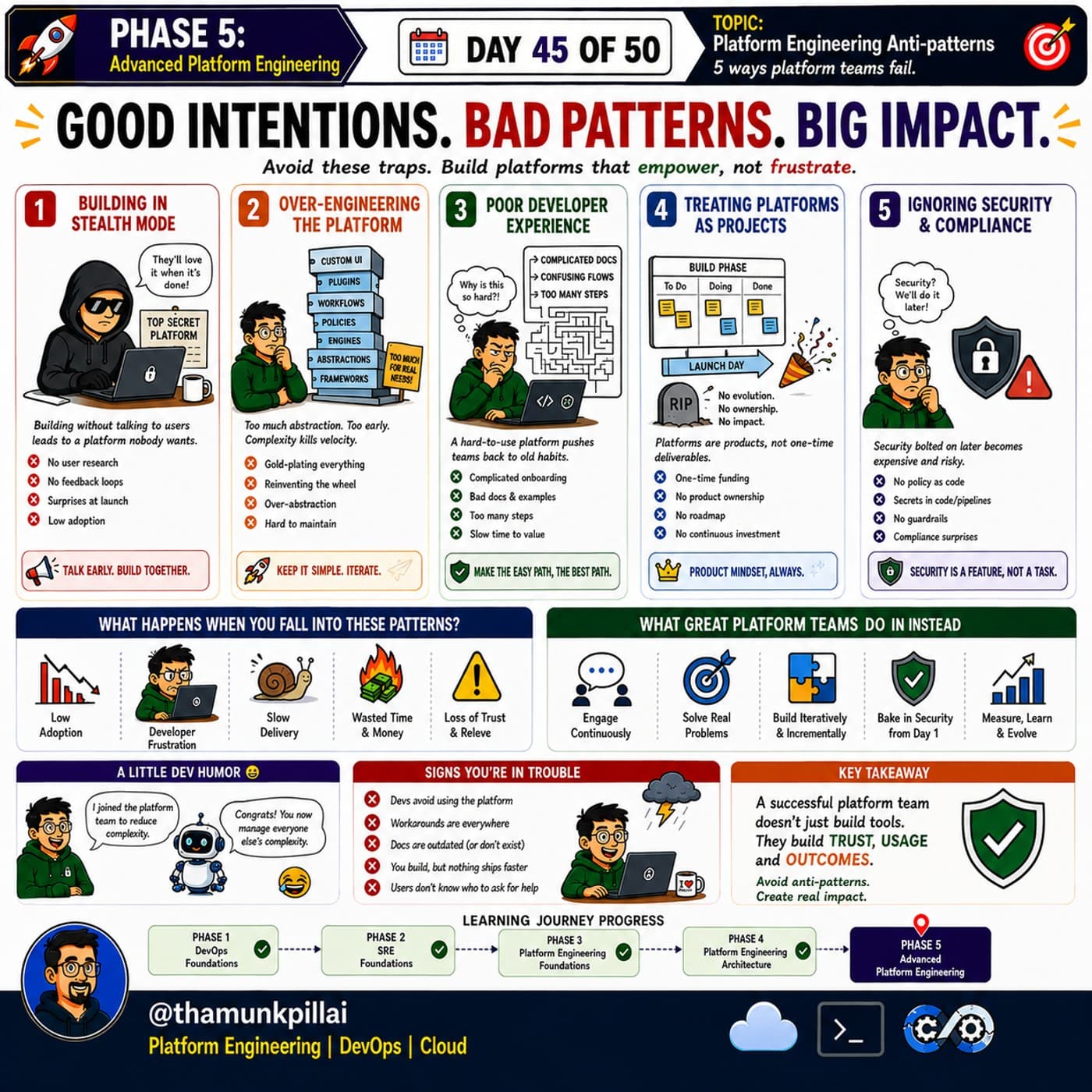
The failure mode that undoes all of this is subtle: a platform team that builds what it finds technically interesting rather than what's actually blocking teams. A beautifully engineered internal tool nobody asked for is still a failure — worse than a failure, actually, because it consumed real budget and real headcount while the friction it was supposed to remove is still there.
Not a new team. A new mindset.
The framing that trips people up is thinking of a platform team as an infrastructure-ownership team with a new name — the group that controls the servers, gatekeeps deploys, and has to sign off before anything ships. That's the exact opposite of the goal. A platform team isn't there to own infrastructure for its own sake; it's there to enable every other team to move faster and safer without having to become infrastructure experts themselves. The moment a platform starts feeling like a gate instead of a paved road, it's failed at the one job it exists to do.
The compact version
Platform teams multiply developer productivity by building the right thing once and enabling everyone to move fast, safely, and consistently on top of it. Spotify's Backstage, Uber's internal tooling, Airbnb's self-service infrastructure — none of those exist because someone wanted to own more infrastructure. They exist because thousands of engineers needed to stop solving the same problems independently.
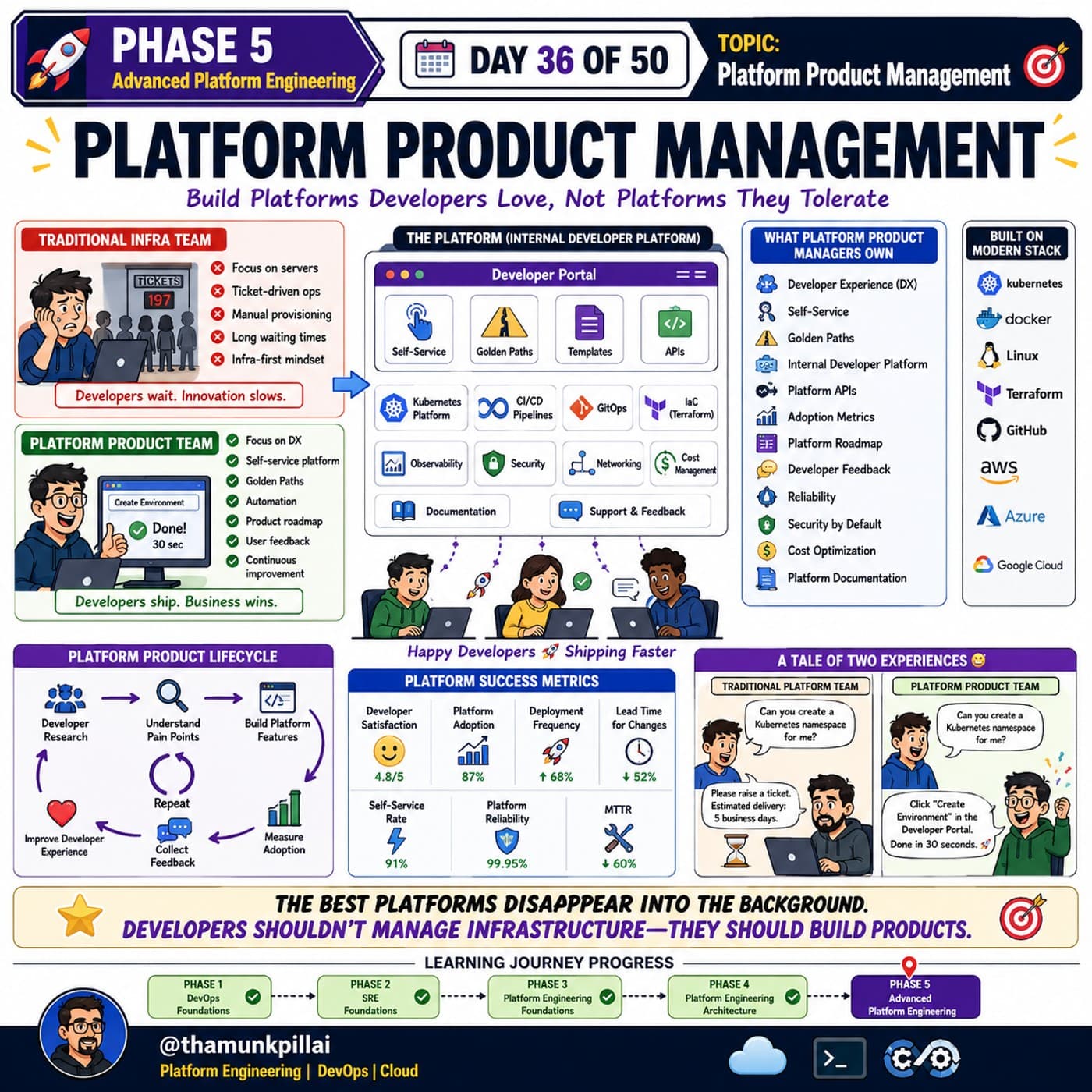
Tomorrow's article covers the mistake that undoes even a well-intentioned platform team: treating the platform as a project that gets "delivered" once, instead of a product that has to earn its adoption, continuously, the same way any product does.