Ask most engineers whether application code should be version-controlled, code-reviewed, and tested before it ships, and the answer is an automatic yes — it's not even a question anymore. Ask the same team whether the production VPC configuration, the security group rules, or the database instance sizing meets that same bar, and the honest answer, in a lot of organizations, is: it's whatever's currently configured in the console, changed by whoever had access and a reason, tracked nowhere except the change itself.
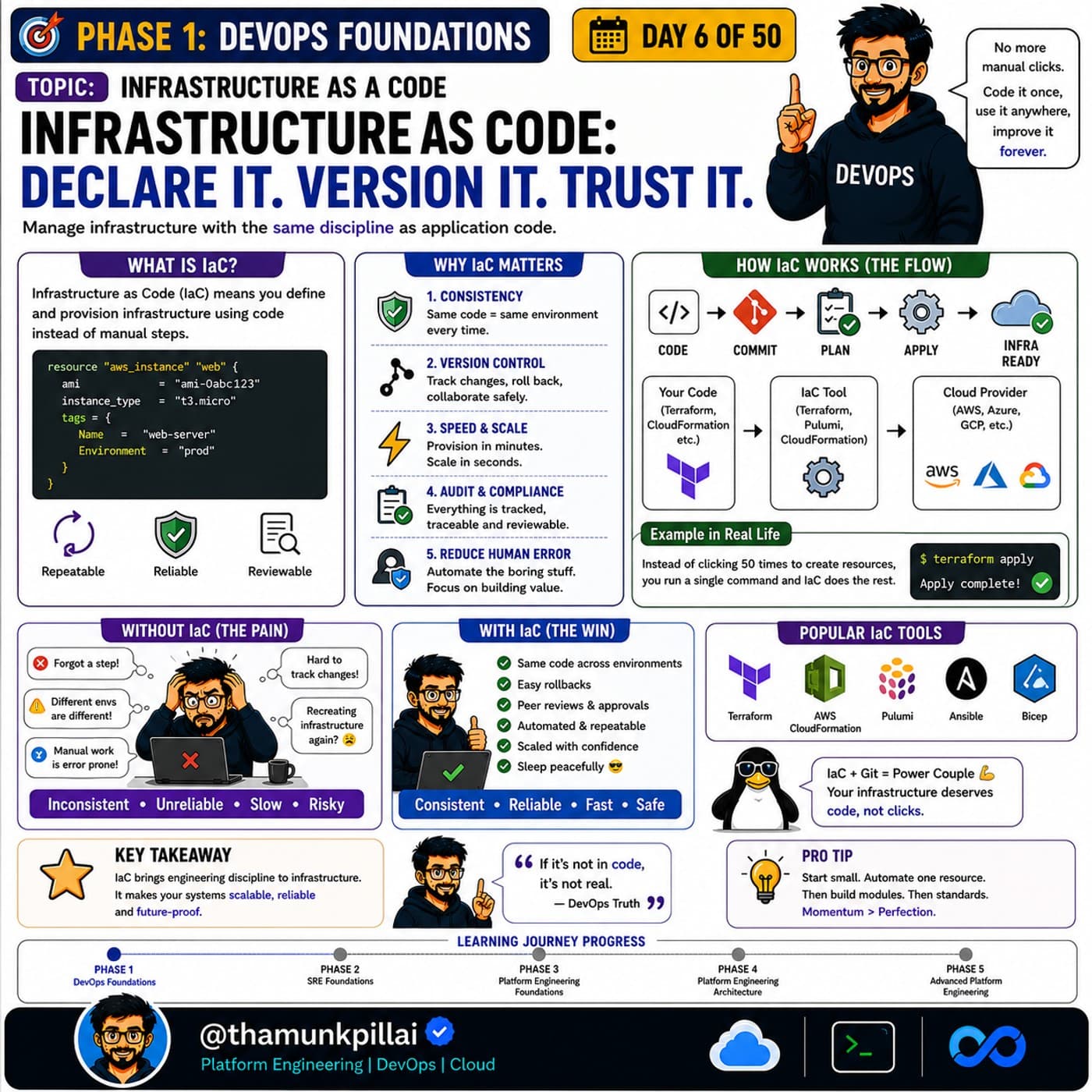
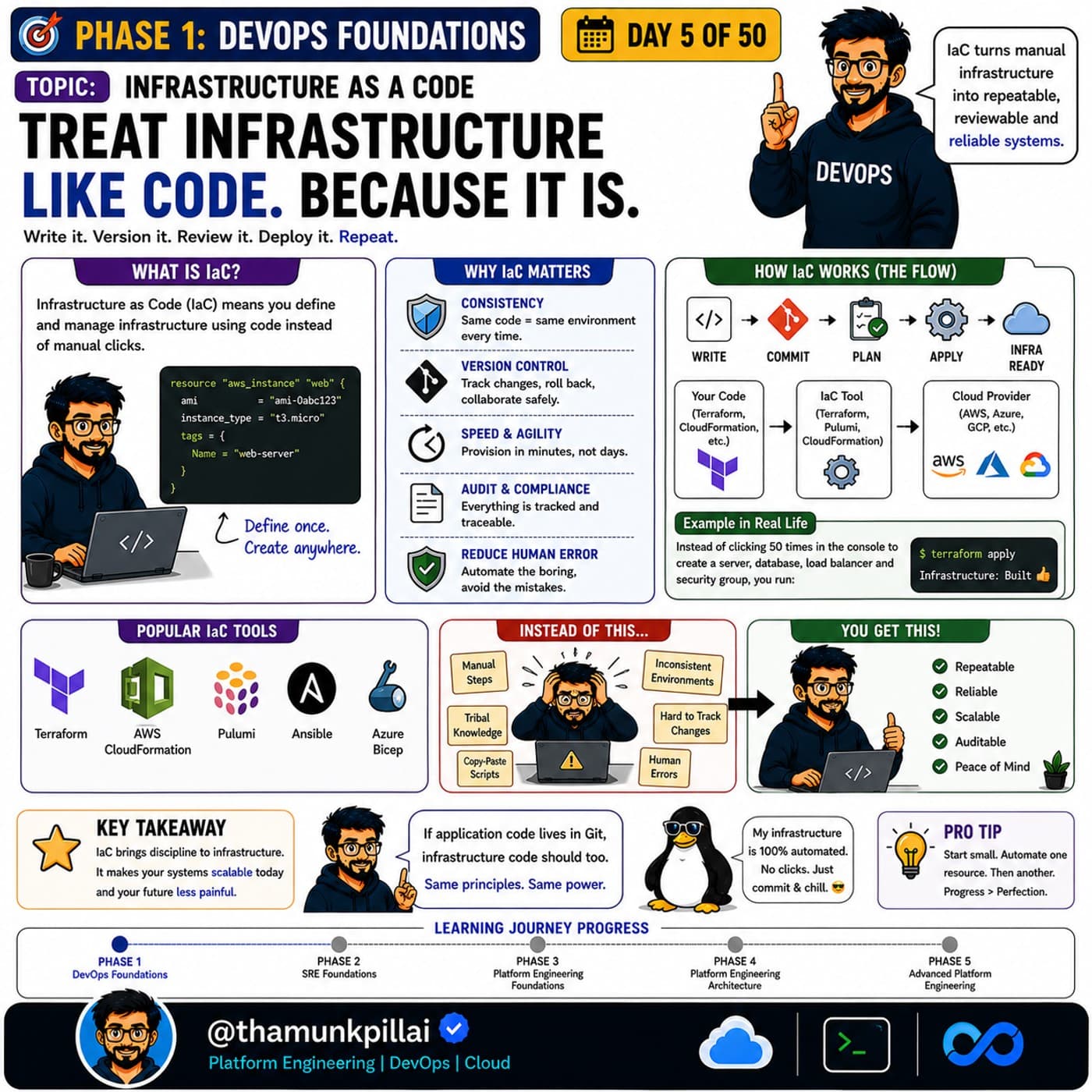
Infrastructure as Code (IaC) is the practice of closing that gap — defining and managing infrastructure using code instead of manual clicks, so that infrastructure gets the same guarantees application code has had for decades.
What actually changes when infrastructure becomes code
The shift isn't cosmetic. Four concrete properties fall out of treating infrastructure as code rather than as console state:
- Consistency. The same code produces the same environment, every time, whether it's your third environment or your thirtieth. No configuration drift from an engineer who clicked slightly differently in staging than they did in prod.
- Version control. Every infrastructure change has a diff, an author, and a commit message. Rolling back a bad change is
git revert, not a forensic reconstruction of what the console used to look like. - Speed. Provisioning becomes a
terraform apply, measured in minutes, instead of a change ticket with a multi-day SLA and a human on the other end who has to interpret what you actually want. - Auditability. Every change is tracked and traceable by construction, not because someone remembered to write it down after the fact.
Note
The console isn't the problem. The problem is that console changes are invisible to everyone who wasn't watching when they happened. IaC doesn't make infrastructure harder to change — it makes changes visible to the whole team, by default, forever.
The tooling landscape, briefly
Terraform is the closest thing to a default choice for multi-cloud IaC — declarative, provider-agnostic, with a huge ecosystem of modules. AWS CloudFormation and Azure Bicep are cloud-native equivalents, tightly integrated with their respective platforms but locked to them. Pulumi takes a different approach, letting you write infrastructure definitions in a general-purpose language instead of a domain-specific one, which is powerful and also a discipline risk — "real code" invites abstractions and cleverness that a constrained DSL naturally discourages. Ansible sits slightly to the side of this group, oriented more toward configuration management than provisioning, though the line between the two has blurred.
None of these tools is the point. The point is the discipline they enforce: write it, commit it, review it, apply it. The specific tool is a implementation detail that should be chosen for your team's constraints, not treated as the definition of "doing IaC."
What you're actually trading away from the old way
The manual alternative — clicking through a console, copy-pasting scripts between engineers, relying on whoever's been here longest to remember why a setting is configured the way it is — has a specific and consistent failure pattern: it works fine until it doesn't, and when it breaks, nobody can explain with confidence what state production is actually in, only what it's supposed to be in.
A test worth running
Pick any piece of your production infrastructure at random and ask: if this were destroyed right now, could we recreate it exactly, from code, without anyone's memory being load-bearing? If the honest answer is no, that's not a hypothetical risk — that's a description of your current bus factor.
Where this goes next
Adopting IaC as a tool is the easy part — install Terraform, write a .tf file, run apply. Adopting it as a discipline — consistent module design, real code review on infrastructure changes, state that doesn't drift, a team that trusts the code over the console — is the harder and more valuable part, and it's what actually determines whether IaC delivers on its promise six months in or quietly rots into "the thing we sometimes remember to update." That discipline is what tomorrow's article covers.
Define once. Create anywhere. Start small, automate one resource, then the next. Progress beats perfection here, same as everywhere else in this series.