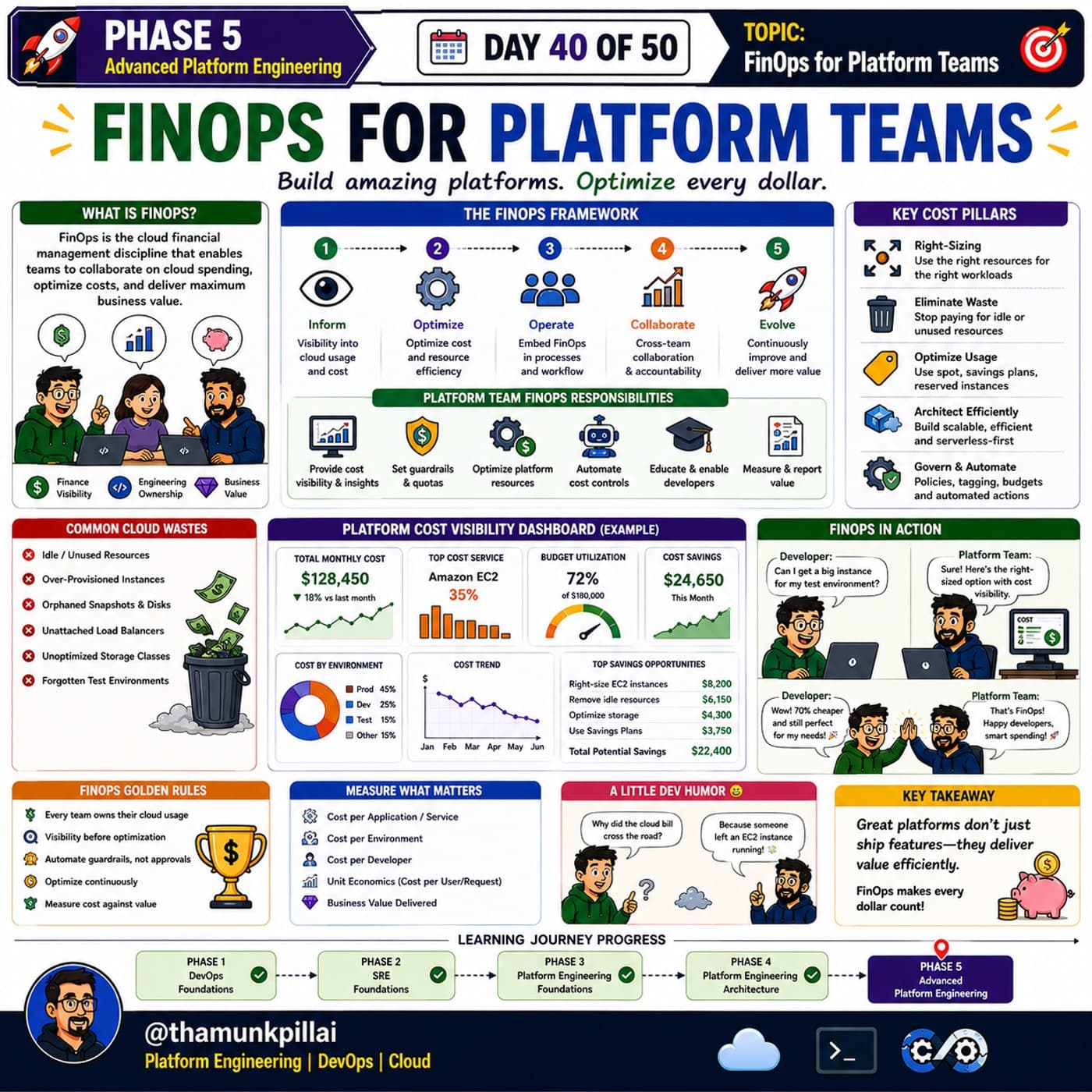
"Why did the cloud bill cross the road?" "Because someone left an EC2 instance running." The joke works because the scenario is completely ordinary — orphaned resources, over-provisioned instances, forgotten test environments are the default state of cloud spend in any org that isn't deliberately watching it. FinOps is the cloud financial management discipline that turns "watching it" into an actual practice: Finance, Engineering, and Business collaborating on cloud spending, with real visibility, real ownership, and real optimization — not a monthly bill that arrives as a surprise to everyone.
Note
The distinction that makes FinOps different from "cost cutting": every team owns their cloud usage, and visibility comes before optimization. You can't right-size what you can't see, and a platform team that tries to cut costs without first giving teams visibility into their own spend is optimizing blind — likely to cut the wrong thing, or to create friction without actually changing behavior.
The FinOps framework, as a cycle, not a project
1. Inform      → visibility into cloud usage and cost
2. Optimize    → optimize cost and resource efficiency
3. Operate     → embed FinOps into everyday processes and workflow
4. Collaborate → cross-team collaboration and accountability
5. Evolve      → continuously improve and deliver more value
    ↺ (back to Inform — this is a loop, not a one-time initiative)
This is the same shape as Day 21's product lifecycle and Day 36's platform product management loop — FinOps done well is never "complete," because cloud usage keeps changing as the platform and the teams on it grow. A cost optimization pass that isn't repeated becomes stale the moment usage patterns shift.
What a platform team specifically owns in this framework
- Provide cost visibility & insights — dashboards that show teams their own spend, not just a total the platform team sees.
- Set guardrails & quotas — budget alerts and resource limits enforced automatically, the same guardrail-not-gate philosophy from Day 26.
- Optimize platform resources — right-sizing, reserved and spot capacity, efficient architecture as platform defaults, not something each team re-solves.
- Automate cost controls — auto-scaling, scheduled shutdown of idle non-production resources, policy-enforced tagging.
- Educate & enable developers — cost literacy as part of onboarding, not an afterthought discovered at the first uncomfortable bill review.
- Measure & report value — cost per service, cost per environment, cost against the business value actually delivered.
What a real cost dashboard actually surfaces
Total monthly cost: $128,450 (↓18% vs last month)
Top cost service:   Amazon EC2 — 35%
Budget utilization: 72% of $180,000
Cost savings this month: $24,650

Top savings opportunities:
  Right-size EC2 instances   → $8,200
  Remove idle resources      → $6,150
  Optimize storage            → $4,300
  Use savings plans            → $3,750
  Total potential savings: $22,400
The specific value of a dashboard shaped like this isn't the top-line number — it's "top savings opportunities" being concrete and actionable rather than a vague instruction to "spend less." A developer told to cut costs with no visibility will guess. A developer shown "$8,200 available from right-sizing these specific instances" can act immediately.
Measure what matters, at the right granularity
Cost per application or service, cost per environment, cost per developer, and — most tellingly — unit economics like cost per user or cost per request, alongside the business value actually delivered. Aggregate cloud spend alone tells you almost nothing useful; cost relative to the value it's producing is what tells a platform team whether spend is healthy or just large.
The golden rules that keep this from becoming a one-time cost-cutting exercise
Every team owns their cloud usage — cost accountability distributed, not centralized in a platform team nobody else has to think about. Visibility before optimization — you don't cut what you can't see clearly. Automate guardrails, not approvals — the same guardrails-not-gates principle from Day 26, applied to spend instead of security. Optimize continuously, not once a quarter. Measure cost against value delivered, not cost in isolation.
"Great platforms don't just ship features — they deliver value efficiently. FinOps makes every dollar count." That's the actual measure of a mature platform team: not just that developers can self-serve infrastructure, but that the infrastructure they're self-serving is priced and optimized as carefully as the platform's own reliability and security. Tomorrow's article covers the other discipline that has to run through every layer of the platform the same way FinOps does: security and policy as code, enforced automatically rather than reviewed manually.