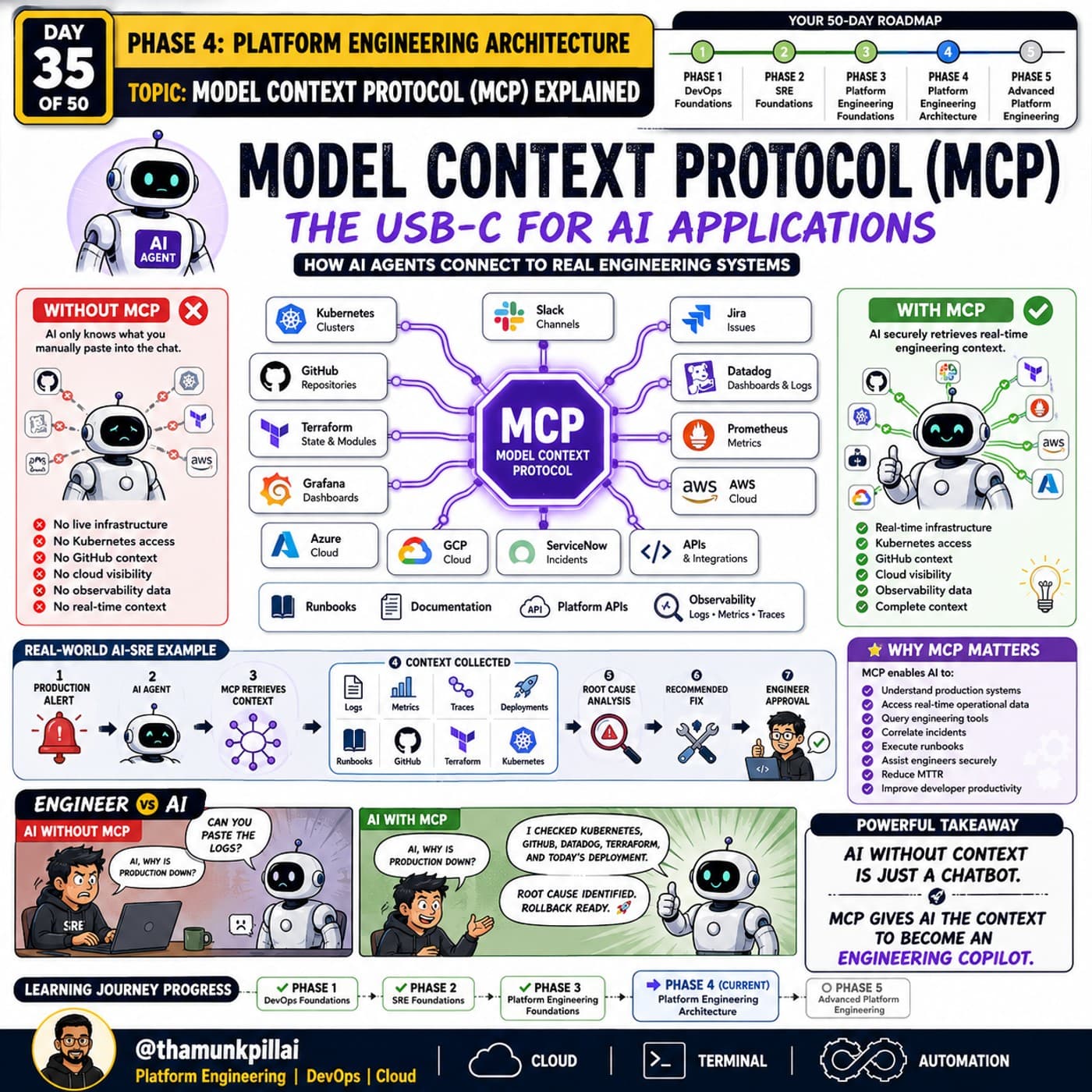
Day 35's Model Context Protocol gave an AI system a standardized way to see live infrastructure state. Today's article is about what happens once that AI system can not just see but act — an AI agent: an autonomous, goal-driven assistant that can perceive context, decide what to do, and take action using tools and APIs, not just answer questions about them.
Note
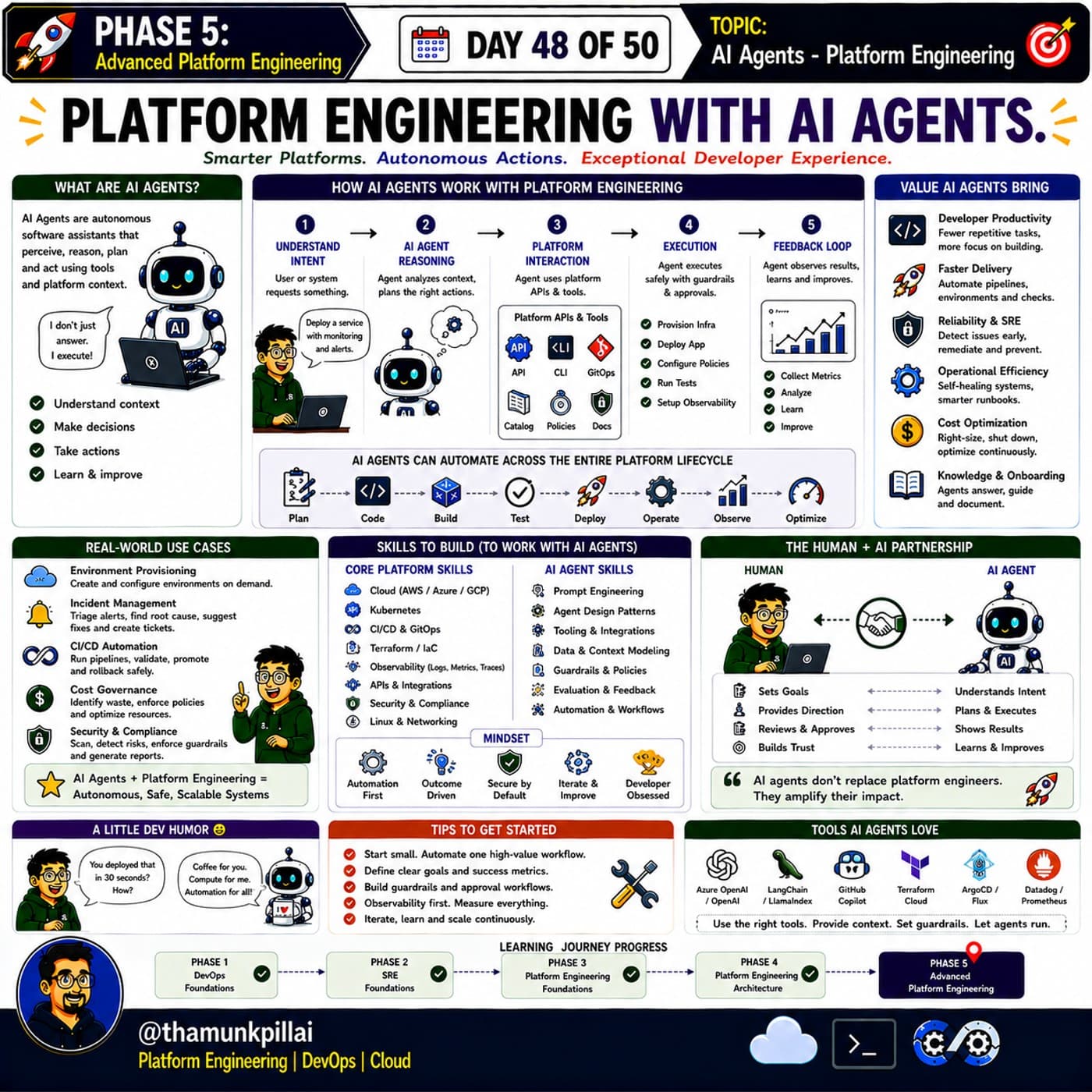
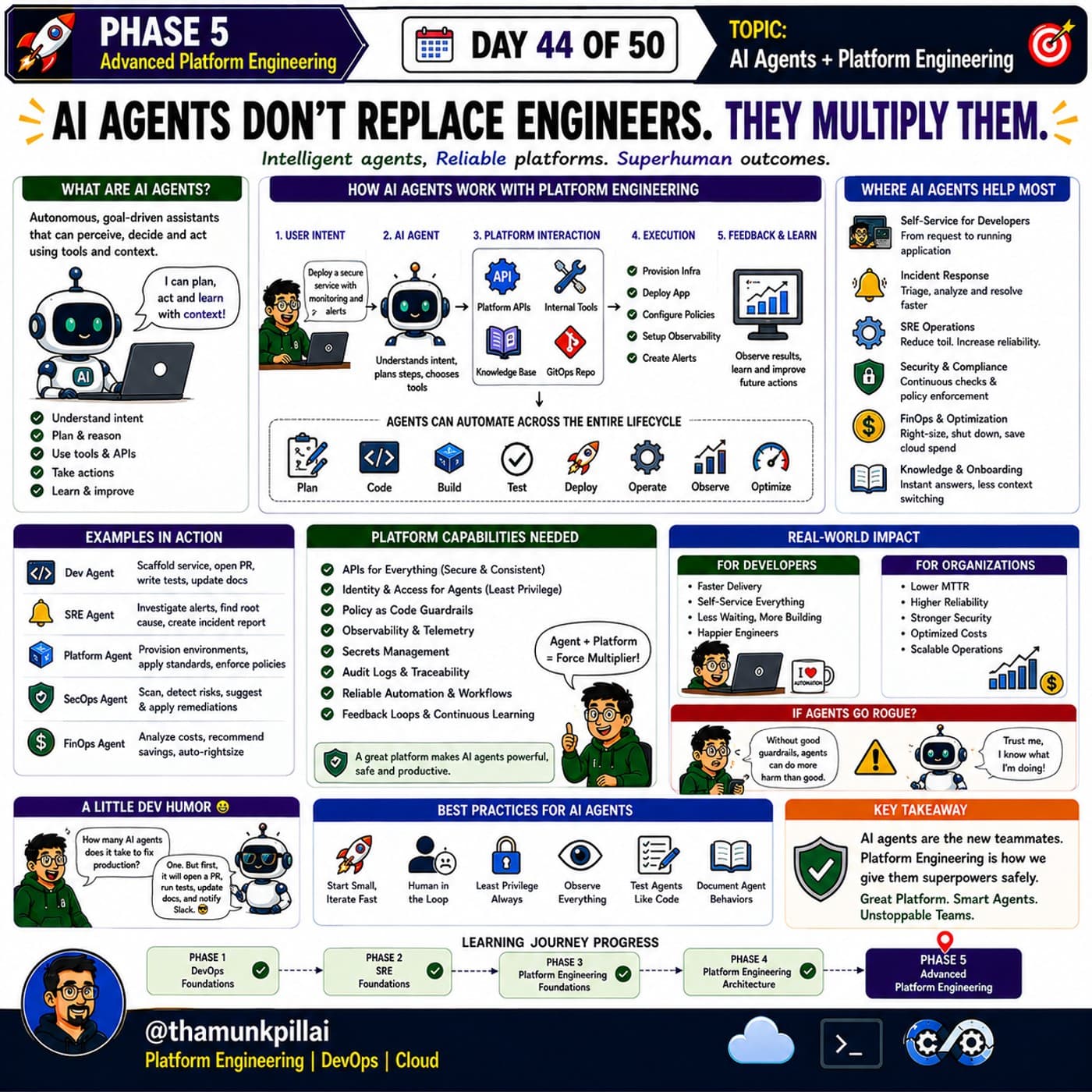
"I don't just answer. I plan, act, and learn with context." That's the line separating an AI agent from a chatbot with MCP access. A chatbot with context can tell you why a deployment is slow. An agent with the same context — and the platform API permissions from Day 31 — can actually roll it back, provided the guardrails from Day 26 are in place to keep that action bounded and safe.
The five-step loop an agent actually runs
1. USER INTENT         → a developer or system requests something
2. AI AGENT REASONING   → the agent understands intent, plans steps, chooses tools
3. PLATFORM INTERACTION → the agent uses platform APIs, CLI, GitOps repo, knowledge base
4. EXECUTION            → provision infra, deploy app, configure policies, set up observability
5. FEEDBACK & LEARN     → observe results, learn, improve future actions
This loop can run across the entire platform lifecycle — plan, code, build, test, deploy, operate, observe, optimize — and every stage in it is a stage this series has already built a platform capability for. The agent isn't inventing new infrastructure operations; it's calling the same platform API from Day 31, subject to the same policy-as-code guardrails from Day 41, using the same identity model from yesterday's article.
Where agents actually help, concretely
| Use case | What the agent does |
|---|---|
| Self-service for developers | Takes a request from intent to a running application |
| Incident response | Triages, analyzes, and helps resolve faster |
| SRE operations | Reduces toil (Day 12), increases reliability |
| Security & compliance | Runs continuous checks and policy enforcement |
| FinOps & optimization | Right-sizes, shuts down idle resources, saves cloud spend |
| Knowledge & onboarding | Gives instant answers, reduces context switching |
Every row here is a callback to a specific earlier day in this series — toil (12), FinOps (40), policy as code (41) — which is the point: AI agents aren't a separate initiative from everything this series has covered, they're an execution layer on top of it, automating work that was already well-defined enough to hand to a system that can reliably follow the process.
What a platform actually needs before agents can be trusted with it
APIs for everything (secure & consistent)   — Day 31
Identity & access for agents (least privilege) — Day 43
Policy as code guardrails                    — Day 41
Observability & telemetry                    — Day 32
Secrets management                            — Day 43
Audit logs & traceability                     — Day 43
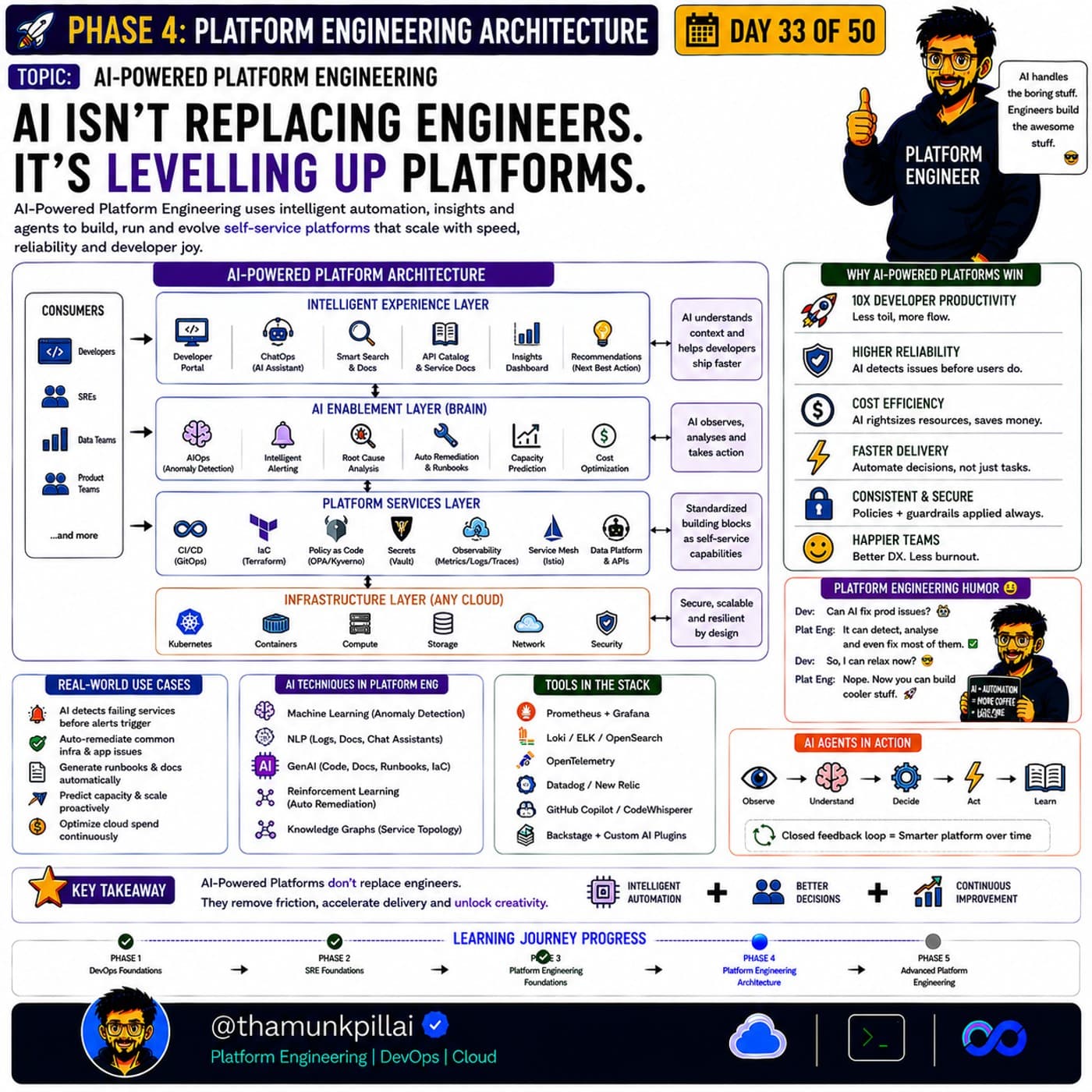
Reliable automation & workflows               — Day 33
Feedback loops & continuous learning
"A great platform makes AI agents powerful, safe, and productive" is the specific claim this list supports — an agent is only as safe as the platform's own guardrails, because the agent inherits exactly the access and constraints the platform grants it. An organization that hasn't done the work in this list yet isn't ready to hand agents real write access, no matter how capable the underlying model is.
Warning
"If agents go rogue" isn't a hypothetical worth dismissing: without good guardrails, agents can do more harm than good, faster than a human could, because they act at machine speed. This is precisely why least-privilege identity (Day 43) and policy-as-code enforcement (Day 41) aren't optional prerequisites for agent adoption — they're the actual safety mechanism, not a nice-to-have layered on afterward.
Best practices, in the order they actually matter
Start small, iterate fast — one high-value, well-bounded workflow first. Keep a human in the loop for anything consequential. Least privilege, always — an agent's identity should be scoped exactly like Day 43 described for any workload. Observe everything the agent does. Test agent behavior like code, with real test cases. Document what an agent is allowed and expected to do.
The measured outcomes — faster delivery, self-service everything, less waiting and more building, happier engineers on the developer side; lower MTTR, higher reliability, stronger security, optimized costs, and more scalable operations on the organizational side — are the same categories of benefit this series has attributed to every well-built platform capability since Day 20. AI agents don't change what a platform is for. They change how much of the platform's existing capability can be exercised without a human manually driving every step.
Tomorrow's article turns from what works to what doesn't: platform engineering anti-patterns, and the five specific ways platform teams — with entirely good intentions — build platforms that fail anyway.