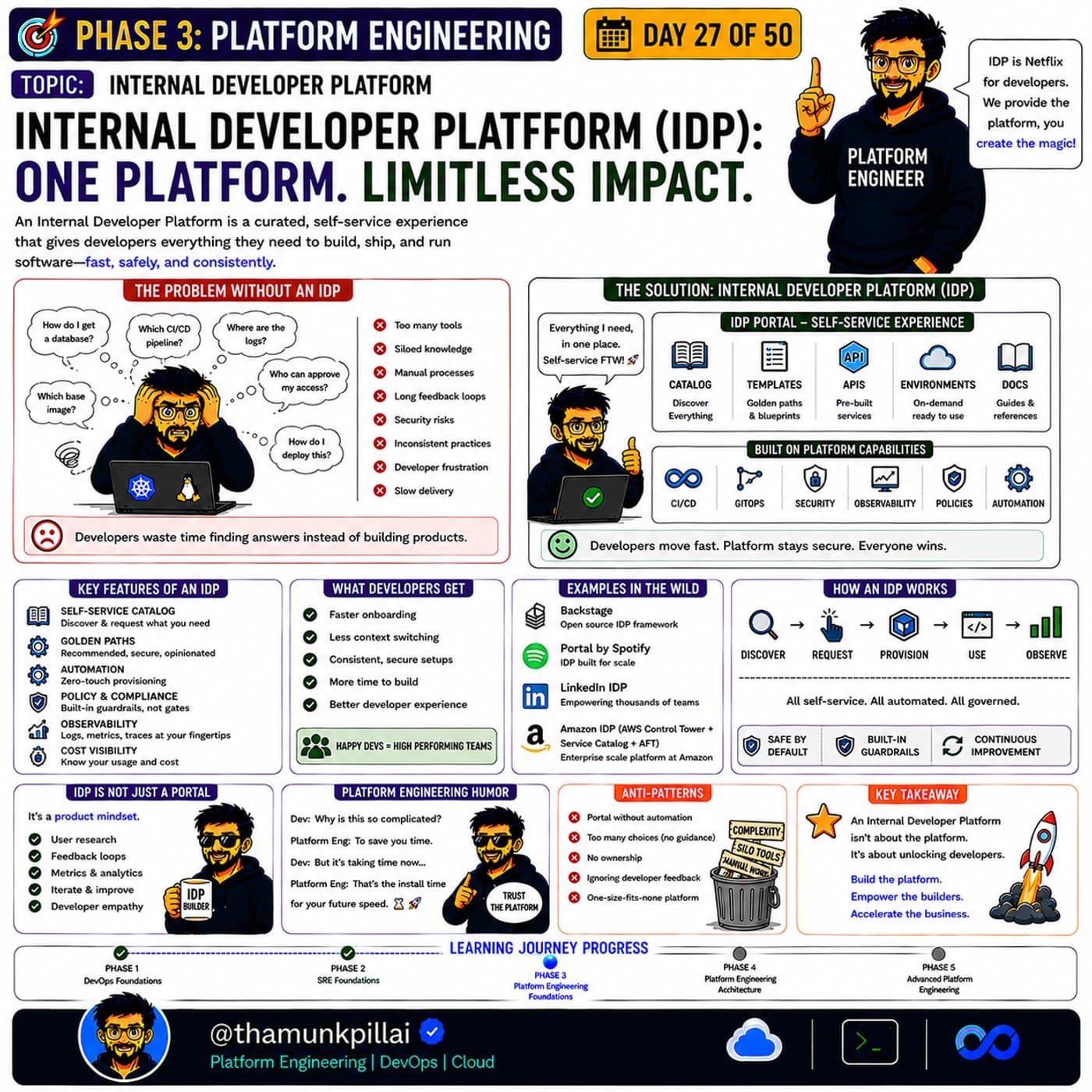
Every concept the last four days of this series have covered — self-service, golden paths, guardrails instead of gates — isn't four separate initiatives a platform team runs in parallel. They're facets of one artifact: the Internal Developer Platform. An IDP is a curated, self-service experience that gives developers everything they need to build, ship, and run software fast, safely, and consistently. Today's article is the synthesis: what all of that looks like assembled into one system, rather than four good ideas sitting next to each other.
Note
The comparison worth sitting with: an IDP is Netflix for developers. Netflix doesn't make you build your own streaming infrastructure to watch a show — it hands you a catalog and a play button, and the enormous complexity of encoding, CDNs, and recommendation systems disappears behind that simplicity. An IDP's job is the identical trade: developers get the catalog and the play button; the platform team owns everything that makes pressing play actually work.
What developers experience versus what's underneath
IDP PORTAL — what a developer sees
  Catalog          → discover everything available
  Templates        → golden paths & blueprints (Day 25)
  APIs             → pre-built services, ready to call
  Environments     → on-demand, ready to use
  Docs             → guides and references

BUILT ON PLATFORM CAPABILITIES — what makes it real
  CI/CD, GitOps, Security, Observability, Policies, Automation
The top half is the self-service experience (Day 24). The bottom half is the guardrail-enforced automation (Day 26) that makes the top half safe to expose without a human reviewing every request. Neither half works without the other: a portal with no automation underneath is just a prettier ticket form; automation with no portal on top is powerful but undiscoverable, and undiscoverable capability might as well not exist for the developer who doesn't know to look for it.
Before and after, at the org level
| Without an IDP | With an IDP |
|---|---|
| Too many tools, siloed knowledge | Everything I need, in one place |
| Manual processes, long feedback loops | Self-service, fast feedback |
| Security risks from inconsistent practices | Built-in guardrails, consistent by default |
| Slow, inconsistent delivery | Fast, consistent, secure delivery |
| Developer frustration | Developers move fast; platform stays secure |
What developers actually get out of it
- Faster onboarding — a new engineer's first deploy happens in days, not weeks, because the golden path already exists.
- Less context switching — infrastructure questions are answered by the platform, not by interrupting a colleague.
- Consistent, secure setups — every service inherits the same baseline, not whatever the last engineer remembered to configure.
- More time to build — the actual point of everything else on this list.
Real IDPs, not a hypothetical
Backstage — Spotify's open-source developer portal — is the reference example precisely because it's public: a catalog, golden path templates, and a plugin ecosystem, now used well beyond Spotify. LinkedIn's internal IDP and Amazon's internal platform (built on AWS's own Control Tower and Service Catalog primitives) follow the identical shape at very different scales, which is itself the point — the pattern holds whether the org has fifty engineers or fifty thousand.
The reframe this whole series has been building toward
An Internal Developer Platform isn't about the platform. It's about unlocking developers. Every feature — the catalog, the templates, the guardrails, the automation — earns its place by answering one question: does this let a developer spend more of their day on the 20% of the problem that's actually specific to their product, and less on the 80% that's generic infrastructure every team was re-solving independently?
What comes next in this series
This is the last article in the Platform Engineering Foundations phase — the arc that ran from "platform engineering isn't DevOps" (Day 19) through today's synthesis of the actual product all of it builds toward. Tomorrow starts Platform Engineering Architecture: the anatomy of what a modern platform is actually built from, layer by layer — developer experience, platform services, platform capabilities, and the infrastructure foundation underneath all of it.