Yesterday's multi-cloud control plane leaned on "federated identity" as the answer to inconsistent access across clouds, without unpacking what that actually requires. Today's article is that unpacking. Breaches overwhelmingly start with leaked secrets, and manual secrets management — a password in a config file, a long-lived API key nobody remembers to rotate — simply doesn't scale to the size of platform this series has been describing since Day 27. The fix is a specific, disciplined lifecycle: authenticate, authorize, access, audit, and rotate, applied to every human and every workload without exception.
Note
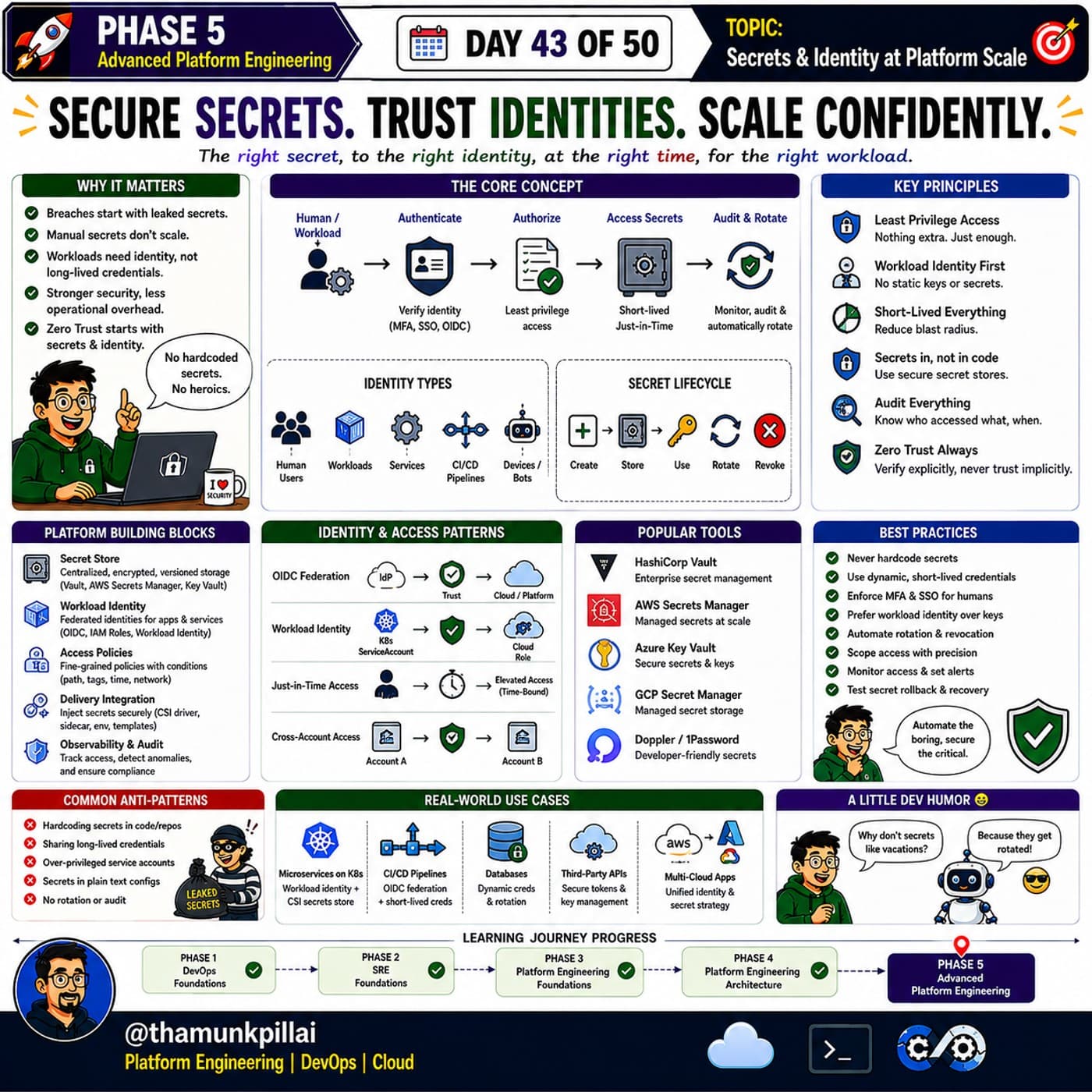
"No hardcoded secrets. No heroics." is the compact version of this entire article. A secret typed into a config file and committed is a breach waiting for someone to find the repository. A secret that's short-lived, scoped, and automatically rotated is one that does far less damage even if it does leak — which is the actual design goal, since assuming zero leaks forever is not a credible security posture at any real scale.
The core lifecycle, end to end
Human / Workload → Authenticate → Authorize → Access Secrets → Audit & Rotate
                    (MFA, SSO,      (least        (short-lived,   (monitor,
                     OIDC)          privilege)     just-in-time)   auto-rotate)
Every stage in that chain matters because skipping any one of them undermines the others. Strong authentication with no least-privilege authorization just means you've confidently verified someone who then gets more access than they need. Least privilege with long-lived credentials means the scope is right today but wrong the moment that person changes roles and nobody revokes the old access. The lifecycle only delivers real security as a complete chain, not as whichever link is easiest to implement first.
Identity types, and why "workload identity first" matters
| Identity type | Example |
|---|---|
| Human users | An engineer authenticating via SSO |
| Workloads | A service authenticating via OIDC, no static credential |
| Services | An internal API calling another internal API |
| CI/CD pipelines | A deploy pipeline requesting short-lived cloud credentials |
| Devices / bots | An automated agent or scheduled job |
Only the first row is a human — everything else is a workload, and workloads historically got the worst security treatment: a static API key baked into a config, valid forever, shared across every environment. "Workload identity first" (day 43's own key principle) means services authenticate the same rigorous way a human does — through federated identity, not a long-lived static secret sitting in a file.
The six principles that hold this together
Least Privilege Access    → Nothing extra. Just enough.
Workload Identity First   → No static keys or secrets.
Short-Lived Everything    → Reduce blast radius.
Secrets In, Not In Code   → Use secure secret stores.
Audit Everything          → Know who accessed what, when.
Zero Trust Always         → Verify explicitly, never trust implicitly.
"Short-lived everything" deserves emphasis because it's the principle that makes the others forgiving of mistakes. A credential that expires in an hour and gets automatically rotated limits how much damage a leak or a missed revocation can actually do — the blast radius shrinks from "however long until someone notices" to "however long until the next rotation," which should be short by design.
Patterns that show up constantly in real platforms
OIDC Federation      → IdP trusts the cloud/platform directly, no shared secret
Workload Identity    → Kubernetes ServiceAccount maps to a cloud role natively
Just-in-Time Access  → Elevated access granted, time-bound, then automatically revoked
Cross-Account Access → Account A assumes a scoped role into Account B, never a shared credential
The anti-patterns that cause the actual breaches
Hardcoding secrets in code or repos. Sharing long-lived credentials across teams or environments. Over-privileged service accounts that have far more access than they use. Secrets sitting in plain-text configs. No rotation or audit trail at all. Every real secrets-related incident traces back to one of these five, which is why "never hardcode secrets" and "automate rotation and revocation" top most platform teams' best-practices lists — they're not generic advice, they're the specific fixes for the specific ways this actually goes wrong.
Why this is the foundation everything else in this phase depends on
Policy as code (Day 41) enforces rules automatically — but only if the system enforcing them can trust that a request is genuinely coming from who or what it claims to be. Multi-cloud consistency (yesterday) depends on federated identity working correctly across every cloud in play. FinOps guardrails depend on knowing which identity is responsible for which spend. Secrets and identity aren't one more item on the platform capability list — they're the layer that makes every other guardrail in this series meaningful rather than merely aspirational.
Tomorrow's article returns to AI agents, this time specifically as consumers of everything this platform provides — and why the identity and access discipline from today becomes even more critical once the thing requesting access isn't a human at all.