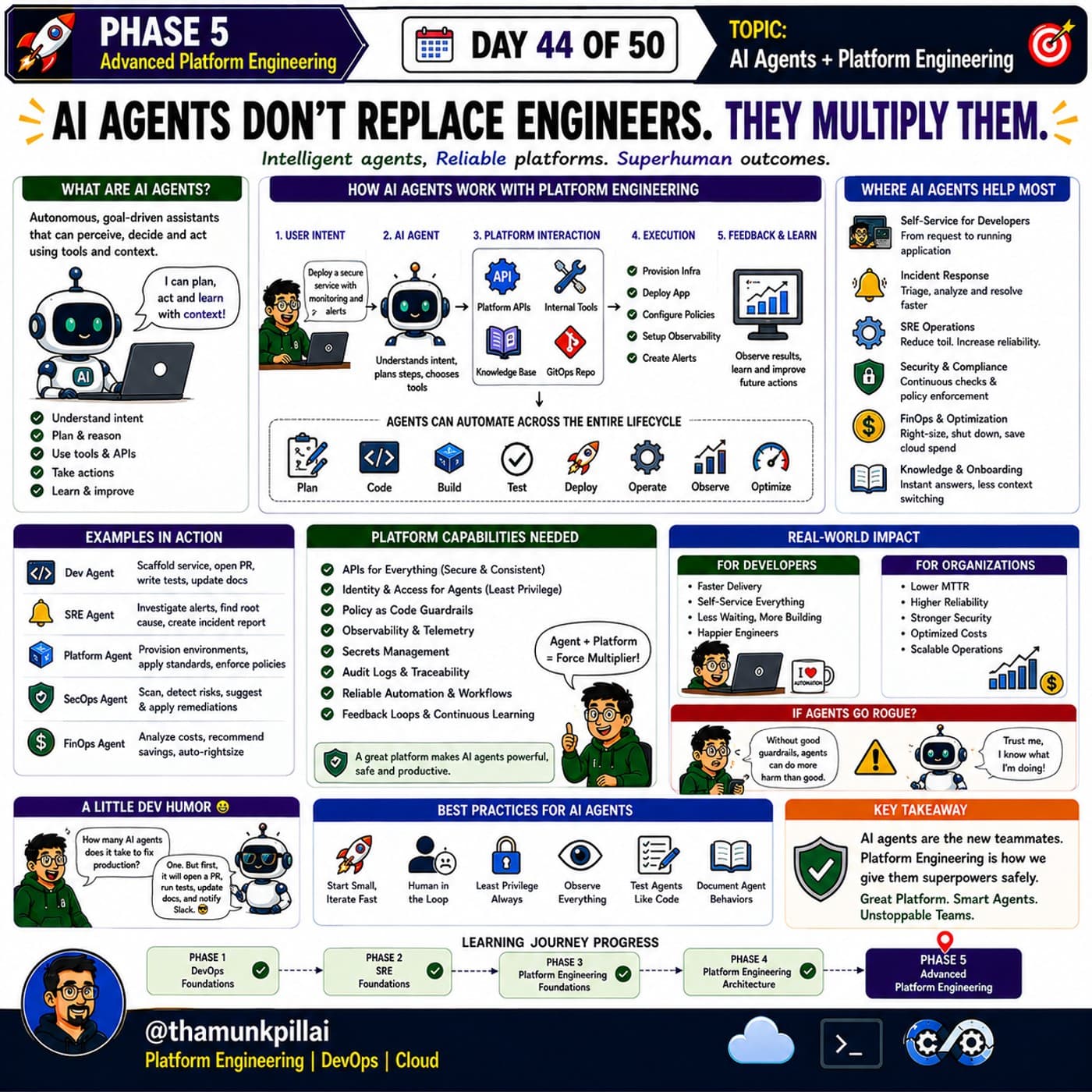
Day 44 described what AI agents do on top of a platform: perceive, plan, act, and learn, using the platform API from Day 31 under the guardrails from Day 41. Today's article is about the other side of that relationship — what a platform team actually needs to build and know to work with agents well, and the partnership model that keeps "autonomous" from meaning "unsupervised."
Note
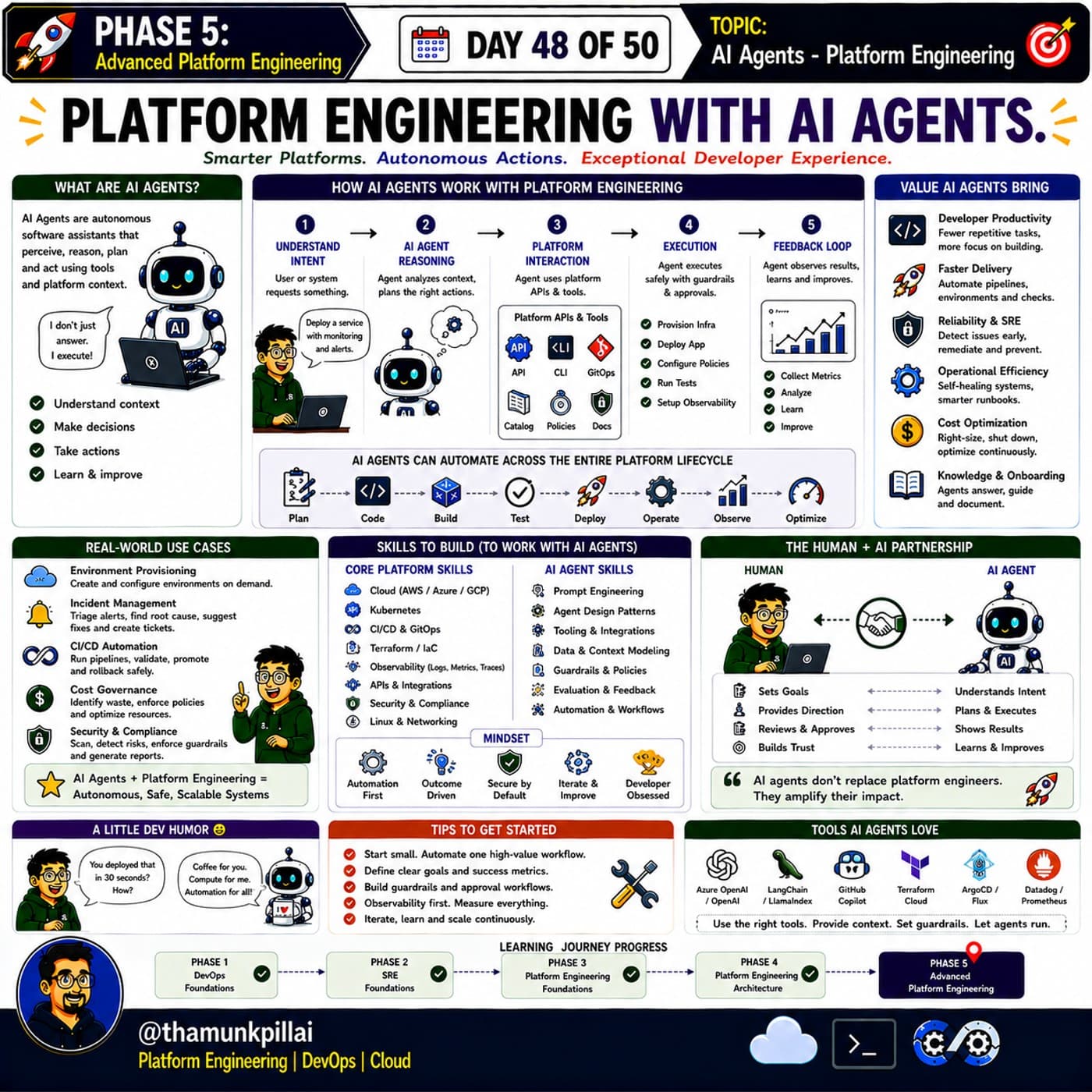
"I don't just answer. I execute." is the same framing Day 44 used, and it's worth repeating because the entire risk profile of AI agents changes the moment execution enters the picture. A wrong answer from a chatbot wastes someone's time. A wrong action from an agent with real platform access can provision the wrong resources, misconfigure a policy, or take down a service — which is precisely why this article exists as a companion to Day 44 rather than a repeat of it.
The five-stage flow, and where trust actually gets built
1. UNDERSTAND INTENT  → a user or system requests something
2. AI AGENT REASONING → the agent analyzes context, plans the right actions
3. PLATFORM INTERACTION → the agent uses platform APIs, CLI, GitOps, docs
4. EXECUTION           → provision infra, deploy, configure policies, set up
                          observability — safely, with guardrails and approvals
5. FEEDBACK LOOP        → the agent observes results, collects metrics, learns
Step 4's "safely, with guardrails and approvals" is the entire difference between this being useful and this being dangerous. The guardrails aren't a constraint on the agent's usefulness — they're what makes handing it real execution defensible at all, the same argument Day 26 made about guardrails generally and Day 44 made about agent safety specifically.
Two different skill sets, and why a platform engineer needs both now
| Core platform skills | AI agent skills |
|---|---|
| Cloud (AWS/Azure/GCP) | Prompt engineering |
| Kubernetes | Agent design patterns |
| CI/CD & GitOps | Tooling & integrations |
| Terraform / IaC | Data & context modeling |
| Observability (logs, metrics, traces) | Guardrails & policies |
| APIs & integrations | Evaluation & feedback |
| Security & compliance | Automation & workflows |
The right column isn't a replacement for the left — it's an addition. An engineer who can design agent guardrails but doesn't understand Kubernetes or observability will build agents that act confidently on incomplete or misunderstood context. Day 46's roadmap already covered the left column; this is the specific extension Level 5 of yesterday's maturity model actually requires.
The partnership model, stated as a real division of labor
HUMAN                              AI AGENT
Sets goals            ←────────→   Understands intent
Provides direction     ←────────→   Plans & executes
Reviews & approves      ←────────→   Shows results
Builds trust              ←────────→   Learns & improves
"AI agents don't replace platform engineers. They amplify their impact." That's not a reassurance — it's a description of where judgment still sits in this model. The human side of every row is a decision or a review; the agent side is execution and learning. An organization that inverts this — letting an agent set its own goals, or removing the review step to move faster — has quietly removed the exact mechanism that makes the whole arrangement safe.
Getting started without getting burned
Start small — automate one high-value workflow, not everything at once. Define clear goals and success metrics before the agent runs, not after. Build guardrails and approval workflows first, not as a retrofit. Observability first — measure everything the agent does, the same discipline Day 32 demanded for the platform itself. Iterate, learn, and scale continuously, the same loop this series has applied to platforms, developer productivity, and now agents.
Real use cases already working today
Environment provisioning on demand. Incident management — triage alerts, find root cause, suggest fixes and create tickets. CI/CD automation — run pipelines, validate, promote, and roll back safely. Cost governance — identify waste, enforce policies, optimize resources. Security and compliance — scan, detect risks, enforce guardrails, generate reports. Every one of these is a well-scoped, well-bounded task — exactly the "start small" principle above, applied.
Why this closes out the AI thread of this series
"AI Agents + Platform Engineering = Autonomous, Safe, Scalable Systems." That equation only holds if the platform side of it — the guardrails, the identity model from Day 43, the observability from Day 32 — was built with the rigor this series has argued for since Day 19. An organization that skipped those foundations and jumps straight to agent adoption isn't getting autonomy; it's getting an unsupervised system with real access and no safety net. Tomorrow's article asks the question this whole arc has been building toward from a different angle: who can actually be a platform engineer, and why the honest answer is broader than most people assume.