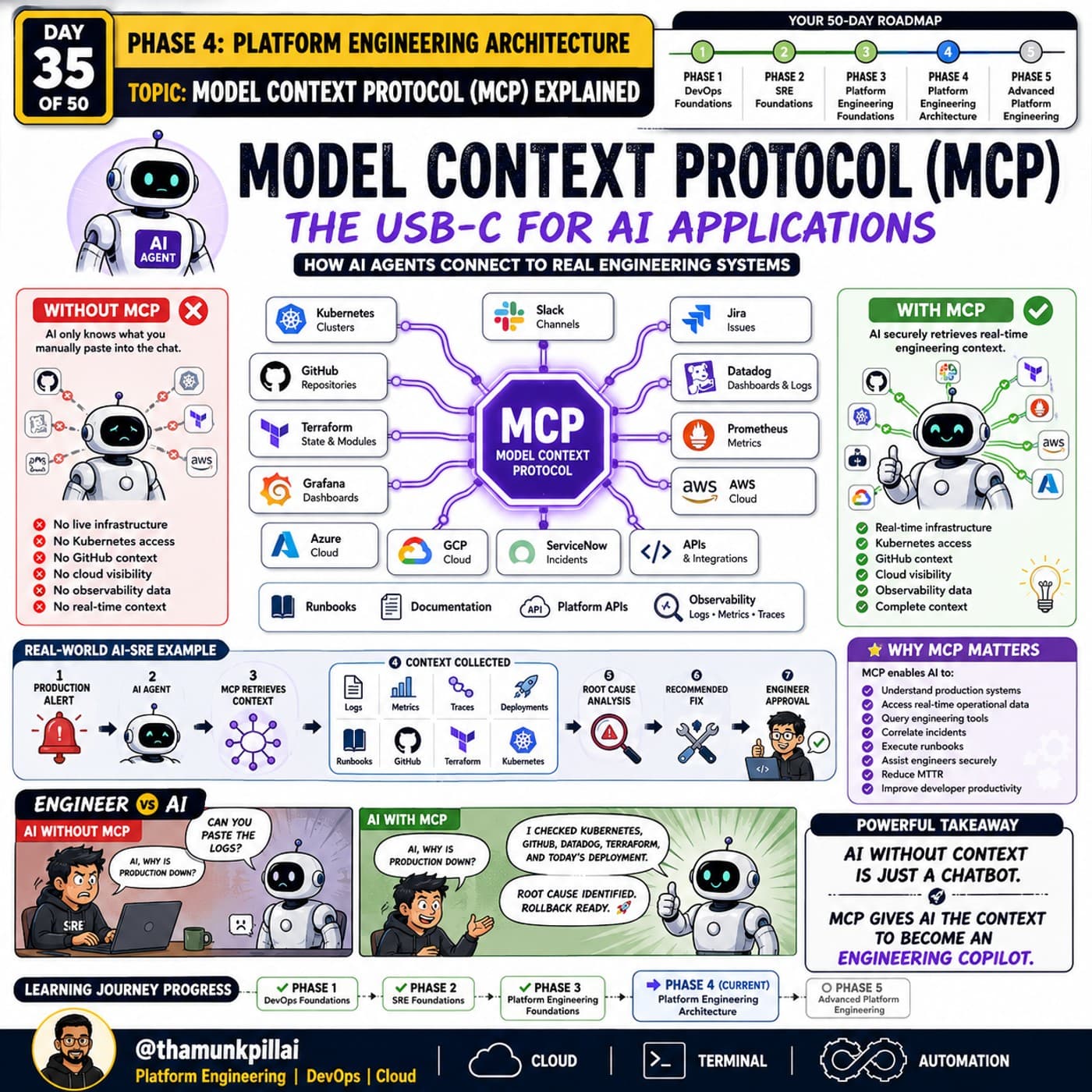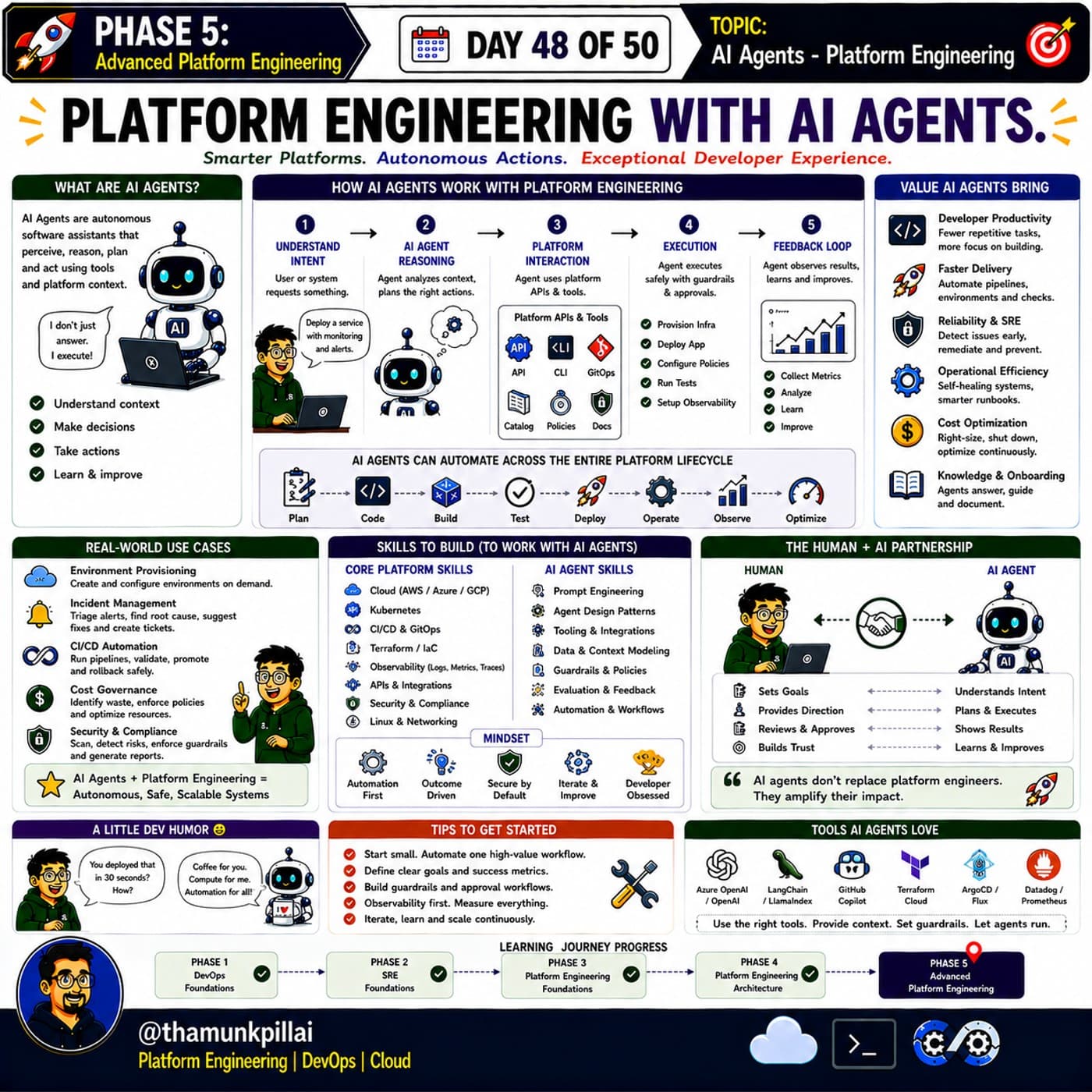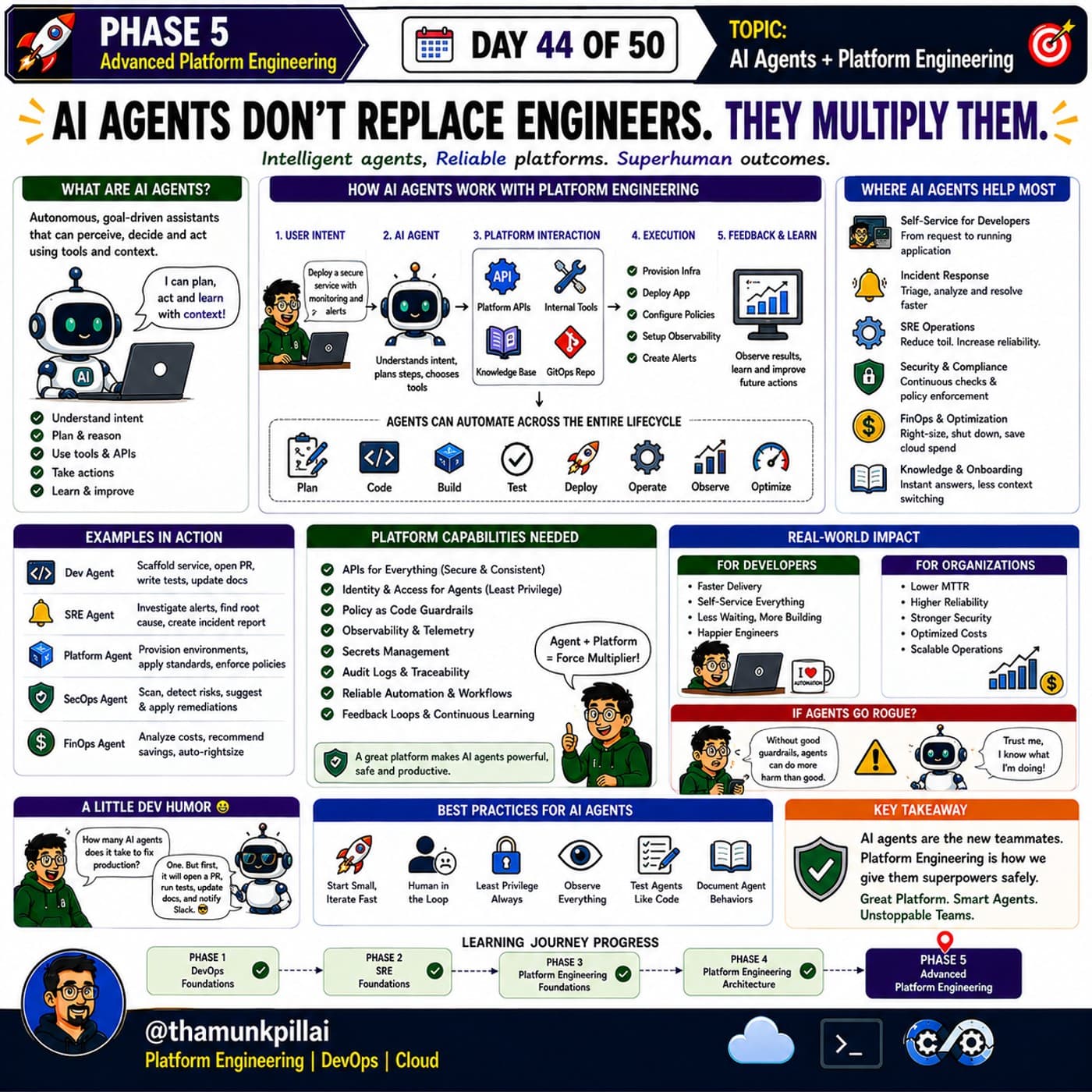
Every layer this series has built up — Kubernetes as the foundation (Day 30), a platform API as the contract (Day 31), observability as the nervous system (Day 32) — produces one thing in enormous volume: telemetry. Metrics, logs, traces, events, usage patterns, all flowing continuously. AI-powered platform engineering is what happens when that telemetry stops being something a human has to stare at and starts being something a system can act on directly — detecting anomalies, correlating root causes, and in bounded cases, remediating automatically.
Note
The framing worth holding onto for this entire article, because it's the one that keeps getting lost in AI hype: AI doesn't replace engineers. It removes friction and accelerates delivery. The engineer's job shifts from manually correlating five dashboards during an incident to reviewing what an AI system already correlated and deciding what to do about it.
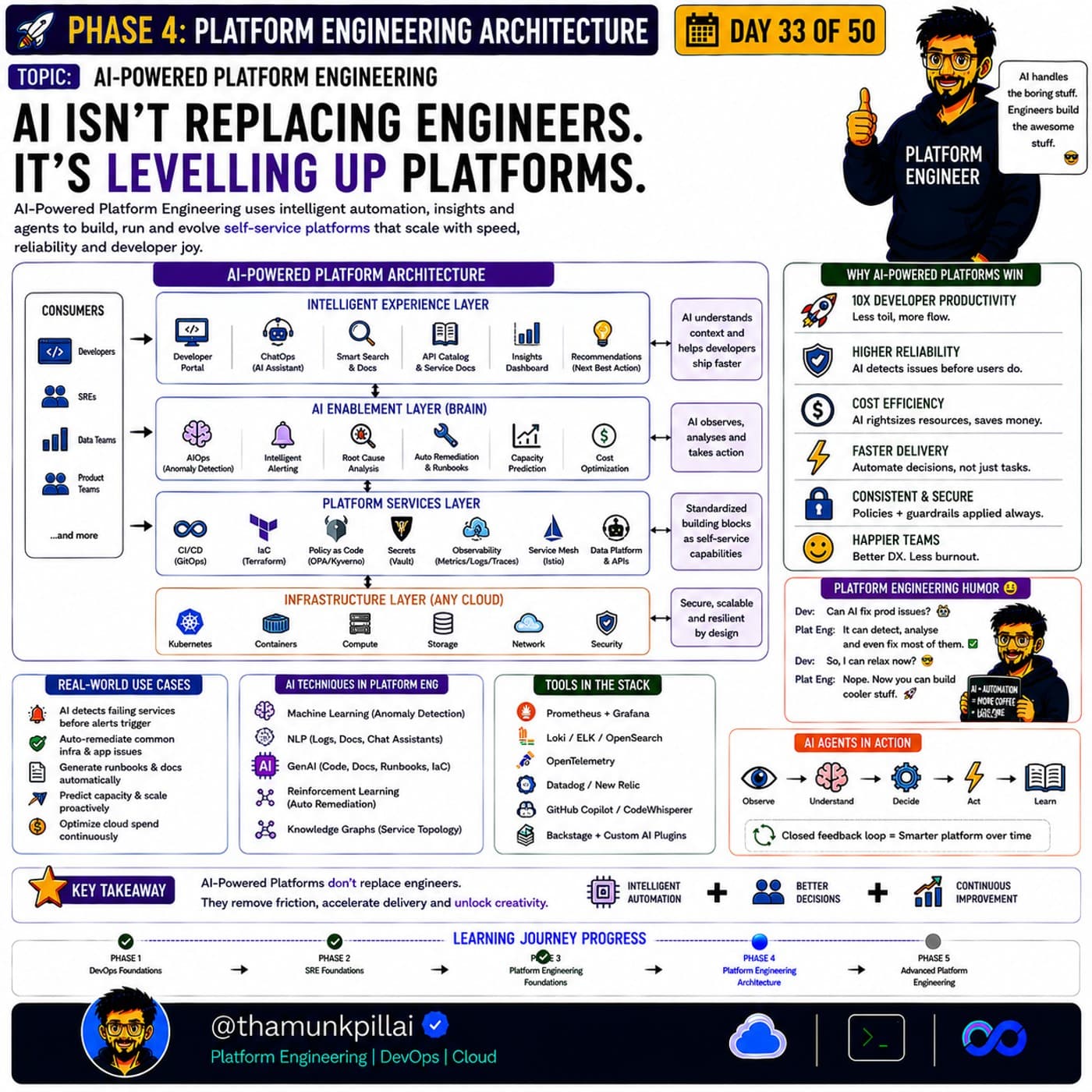
The architecture, one layer at a time
INTELLIGENT EXPERIENCE LAYER
  Developer Portal, ChatOps (AI Assistant), Smart Search & Docs,
  API Catalog & Service Docs, Insights Dashboard, Recommendations

AI ENABLEMENT LAYER (the "brain")
  AIOps (Anomaly Detection), Intelligent Alerting, Root Cause Analysis,
  Auto-Remediation & Runbooks, Capacity Prediction, Cost Optimization

PLATFORM SERVICES LAYER
  CI/CD (GitOps), IaC (Terraform), Policy as Code (OPA/Kyverno),
  Secrets (Vault), Observability (Metrics/Logs/Traces), Service Mesh

INFRASTRUCTURE LAYER (any cloud)
  Kubernetes, Containers, Compute, Storage, Network, Security
Notice the bottom two layers are exactly what Days 28 and 30 already described — nothing about AI changes the underlying architecture. What's new is the "AI Enablement Layer" inserted between the platform services and the developer-facing experience: a layer whose entire job is observing everything the platform services layer produces, understanding it, and deciding what — if anything — needs to happen next.
What this actually looks like as a closed loop
Observe → Understand → Decide → Act → Learn
   ↑                                     |
   └─────────────────────────────────────┘
       (closed feedback loop = smarter platform over time)
That loop is the mechanism, and it's worth being concrete about what each step means: observe is the telemetry from Day 32. Understand is anomaly detection and correlation — recognizing that a latency spike, an error rate increase, and a specific recent deploy are related, not three separate facts. Decide is root cause analysis narrowing "something's wrong" down to a specific, actionable cause. Act is either an automated remediation for a well-understood, low-risk failure mode, or a specific, ready-to-run runbook handed to an engineer for anything riskier. Learn is the loop feeding back — each incident makes the next detection or correlation slightly better.
A concrete example, before and after
| Without AI-powered platform engineering | With it |
|---|---|
| A service degrades; someone notices from a user report | AI detects the failing service before an alert would even trigger |
| An engineer manually checks five dashboards to find the cause | Root cause analysis correlates it automatically across systems |
| A fix gets improvised under pressure | A tested runbook is recommended, or auto-remediation runs directly |
| Postmortem is written from memory afterward | Docs and postmortem drafts get generated from what already happened |
The recurring theme across every row: nothing here is a new capability invented by AI. Anomaly detection, root cause analysis, and runbook automation are all things a sufficiently experienced platform engineer already does. What AI changes is the speed and consistency of doing it — at 3am, on the two-hundredth incident of the quarter, exactly as carefully as the first one.
Where the real leverage is, and where it isn't
The measured outcomes teams report — meaningfully faster developer productivity, higher reliability from catching issues before users do, real cost efficiency from AI right-sizing resources — all come from applying AI to the boring, repetitive, well-understood 80% of platform operations. The genuinely novel 20% — the incident nobody's seen before, the architecture decision with real trade-offs — still needs an engineer's judgment. AI-powered platform engineering done well aims squarely at the first group and doesn't pretend to replace the second.
Why this is a natural extension, not a separate initiative
This isn't a new phase bolted onto platform engineering — it's what platform engineering's existing layers (Kubernetes, platform APIs, observability) unlock once there's enough consistent telemetry flowing through them to train and run real detection and correlation on top. A platform without Day 32's observability discipline has nothing for an AI layer to observe; a platform without Day 30's Kubernetes foundation has no consistent place to act. AI-powered platform engineering is the payoff for having built the previous four days' worth of architecture correctly.
Tomorrow's article goes one layer deeper into the specific discipline this unlocks for reliability work: AI-SRE, and why "AI handles the boring stuff, engineers build the awesome stuff" is a more literal description of the job than it might sound.